Is Haryana Family ID the Same as a Ration Card?
Confused between your PPP Haryana Family ID and ration card? You’re not alone. Thousands of Haryana families mix them up every year. This mistake causes rejected applications, missed food subsidies, and wasted trips to government offices. Here is the clear, factual difference in simple words.
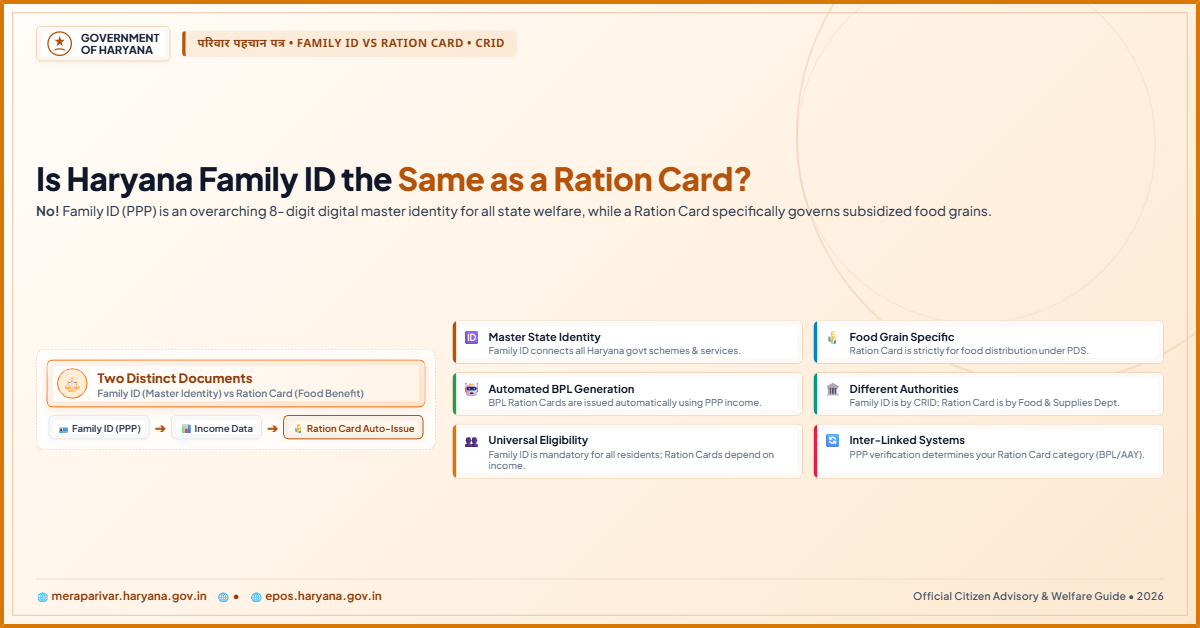
Quick Answer : No, the Haryana Family ID (Parivar Pehchan Patra) is not a ration card. The Family ID is an 8-digit digital identity for your household. A ration card is a separate food subsidy document that the government generates automatically from your Family ID income data.
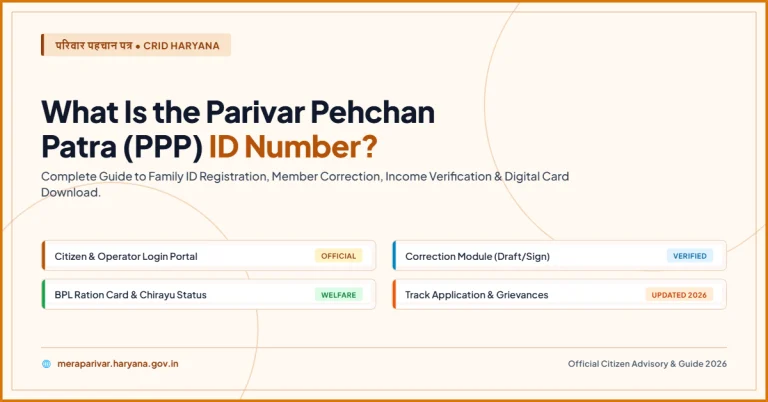
What Is the PPP Haryana Family ID?
The Parivar Pehchan Patra (PPP) is Haryana’s flagship family database, launched in 2020 under the Haryana Parivar Pehchan Act, 2021. Every family living in Haryana receives a unique 8-digit Family ID after registration.
This ID stores your family’s income, address, occupation, and member details in one digital record. More than 77.50 lakh families are registered in the PPP system as of 2026.
The PPP is mandatory for almost every state service. You cannot apply for a domicile certificate, pension, scholarship, or ration card without it.
Families living outside Haryana but applying for a state service get a 9-digit temporary ID starting with the letter ‘T’. Permanent residents always receive the 8-digit version.
What Is a Haryana Ration Card?
A ration card is a food subsidy document issued under the Public Distribution System (PDS). The Food, Civil Supplies & Consumer Affairs Department manages it.
Haryana currently has around 40 lakh ration cards active across the state. The card lets eligible families buy subsidized wheat, rice, and sugar from Fair Price Shops.
Ration cards come in different categories:
- BPL (Below Poverty Line): Yellow card for families with verified annual income below ₹1.80 lakh
- AAY (Antyodaya Anna Yojana): Pink card for the poorest households, providing 35 kg of grain per family monthly
- APL (Above Poverty Line): Green card for families above the income threshold, with limited or no grain subsidy
The OPH (Other Priority Household) category has been abolished. All families with verified income below ₹1.80 lakh now fall under the BPL category.
Why Do People Confuse the Two?
Before 2020, families applied for ration cards separately. Today, the ration card comes out of your Family ID data. That link makes people assume the two are one document.
They are not. Your Aadhaar number is not your bank account. Your Family ID is not your ration card. One identifies you. The other delivers a specific benefit.
Key Differences: Family ID vs Ration Card
| Feature | PPP Haryana Family ID | Haryana Ration Card |
| Primary Purpose | Master family identity for all government services | Food subsidy and fuel distribution |
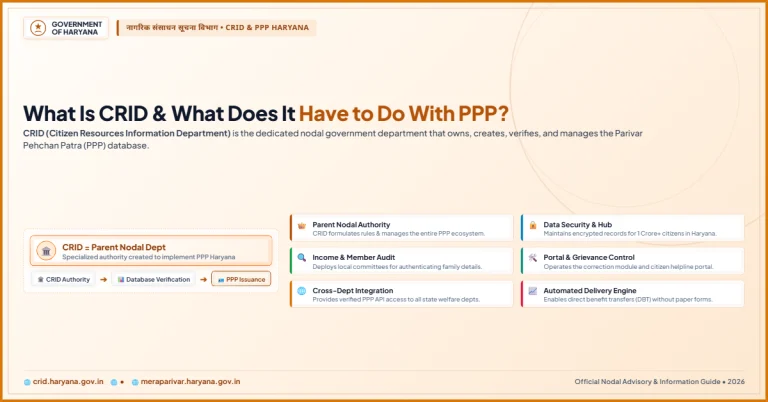
| Issuing Authority | Citizen Resources Information Department (CRID) | Food, Civil Supplies & Consumer Affairs Dept |
| Identifier Format | 8-digit code for permanent residents | Distinct ration card number |
| Mandatory Status | Required for all Haryana residents | Optional; based on income eligibility |
| Income Verification | Tracks verified annual family income | Determined automatically via PPP data |
| Scope | Scholarships, pensions, health, jobs | Limited to ration shop purchases |
Which Document Do You Need for What?
Knowing where each document works saves you a wasted trip. Here is a simple breakdown.
| Task | Document Needed |
| Apply for a pension or scholarship | PPP Haryana Family ID |
| Get a domicile or caste certificate | PPP Haryana Family ID |
| Buy subsidized wheat or rice | Ration card (or Family ID at the shop) |
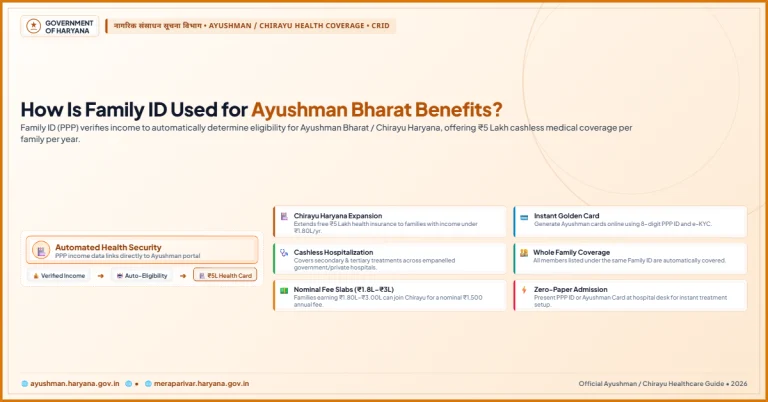
| Apply for Ayushman Bharat health cover | PPP Haryana Family ID |
| Get a new LPG connection under a subsidy scheme | Ration card plus Family ID |
| Update family members after marriage or birth | PPP Haryana Family ID |
The pattern is clear. The Family ID opens doors. The ration card is one room behind those doors.
How the Family ID Controls Ration Card Eligibility
The Government of Haryana removed manual paper applications for ration cards. The system now reads income data stored in the PPP database automatically.
When your verified annual family income falls below ₹1.80 lakh, the State Food Portal generates your e-Ration Card without any separate application.
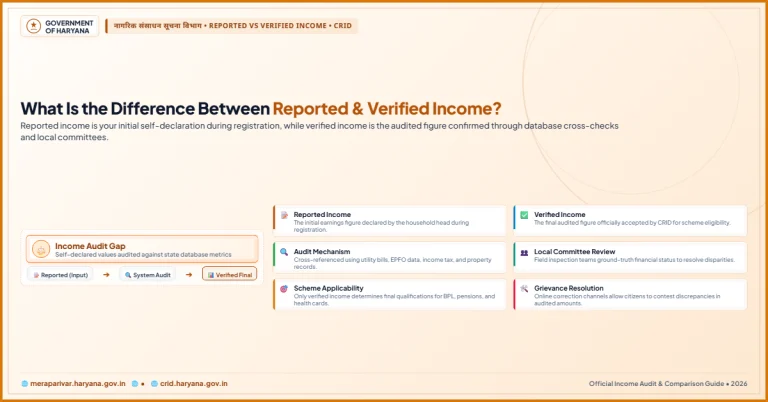
The income verification happens through multiple channels. The government checks CBDT Income Tax Return data, HRMS employee records, electricity consumption patterns, and local committee assessments.
If your verified income rises above the threshold, your ration card benefits stop automatically during the next database refresh.
Steps to Download Your Ration Card Using Family ID
If your family meets the income guidelines, your ration card is already generated online. Follow these steps to access it.
Step 1: Visit the EPDS Portal
Open your browser and go to the official Haryana EPDS website at epds.haryanafood.gov.in. This portal holds the ration card records for every eligible household in the state.
Step 2: Open the Citizen Corner
Click the “Citizen Corner” tab in the top navigation bar. A dropdown menu appears with several options for citizens.
Step 3: Select Download Ration Card
Choose “Download Ration Card” from the dropdown. The page now shows a form that asks for your household details.
Step 4: Enter Your PPP Family ID
Type your 8-digit PPP Haryana Family ID into the designated field. Fill in the captcha code shown on the screen to prove you are a real user.
Step 5: Verify with Mobile OTP
Select the head of the family or an adult member. The system sends a One-Time Password to the Aadhaar-linked mobile number registered in your Family ID profile.
Step 6: Download the PDF
Enter the OTP and click Verify. Your auto-generated e-Ration Card details appear on the screen. Click “Download PDF” to save and print the document.
For corrections or family member updates, visit the official Mera Parivar Haryana portal at meraparivar.haryana.gov.in.
Steps to Register for a PPP Haryana Family ID
If your household is still not registered, follow these steps to get your Family ID first.
Step 1: Visit the Mera Parivar Portal
Go to meraparivar.haryana.gov.in on your phone or computer. This is the single official website for all Parivar Pehchan Patra work in Haryana.
Step 2: Start a New Registration
Select the option to generate a new Parivar Pehchan Patra. Enter your Aadhaar number and mobile number in the given fields.
Step 3: Fill in Family Details
Add the name, age, Aadhaar number, and relationship of every family member. Include the head of the family first.
Step 4: Verify with OTP
Enter the One-Time Password sent to your Aadhaar-linked mobile number. This confirms that the mobile number belongs to your household.
Step 5: Note Your Family ID
The system generates your 8-digit Family ID. Save it. You will use it for every state scheme.
You can also complete registration at any Atal Seva Kendra or Common Service Centre (CSC) in Haryana.
Common Reasons for Missing Ration Cards
If your Family ID is active but no ration card appears on the portal, one of these issues usually explains the delay:
- Unverified Income: The local verification committee has not finalized your annual income figure yet.
- Income Above Threshold: Your verified income exceeds ₹1.80 lakh annually.
- Aadhaar Mismatch: Names, ages, or Aadhaar numbers have spelling differences between records.
- Pending Split or Merge Requests: Unresolved family profile changes pause welfare status updates.
The government discontinued yellow ration cards for 9,60,235 families in December 2022 after verifying PPP data. Keeping your Family ID details accurate prevents such disruptions.
What Happens If You Don’t Fix Errors?
Errors in your Family ID do not stay small. They block every linked benefit at once.
A single wrong income entry can cancel your ration card and your pension in the same cycle. A misspelled name can stop a scholarship payment for a student in the family.
The fix is simple. Check your PPP data twice a year on the Mera Parivar portal. Report errors early. The verification committee updates records during its regular review.
Conclusion
The PPP Haryana Family ID and the ration card work together, but they are separate documents. The Family ID is your household’s digital key. It records verified income and unlocks state benefits. The ration card is one specific welfare service that the system generates from that data.
Keeping your Family ID data accurate ensures smooth access to ration allotments, health schemes, and educational support. Update your income, address, and member details on the Mera Parivar portal whenever your situation changes.
Frequently Asked Questions
1. Is Family ID compulsory to get a ration card in Haryana?
Yes. The state government generates e-ration cards exclusively through verified Family ID database records.
2. Can I use my Family ID directly at a ration shop to collect food grains?
Yes. Fair Price Shops can verify your household eligibility using your 8-digit Family ID or Aadhaar-linked biometric verification.
3. What should I do if my ration card shows the wrong family members?
Log in to the official Mera Parivar portal to correct member details, add new members, or remove outdated entries.
4. How long does it take for a ration card to generate after updating Family ID income?
Once the local committee verifies and updates your income below ₹1.80 lakh on the PPP portal, the e-ration card reflects on the EPDS site during the next monthly database refresh cycle.
5. Does updating my address in Family ID automatically update my ration shop location?
Yes. Updating your residential address in the PPP portal automatically reassigns your household to the nearest local Fair Price Shop.
6. Do non-residents of Haryana get a permanent Family ID?
No. Non-residents or temporary migrants receive a temporary 9-digit ID starting with the letter ‘T’, while permanent residents receive an 8-digit PPP ID.