What Is the Difference Between Reported and Verified Family Income?
Your PPP Haryana Family income figure decides your pension, ration card, and Chirayu premium. Reported income is what you type. Verified income is what the state accepts. That one-word gap—Unverified or Verified—keeps eligible families out of benefits.
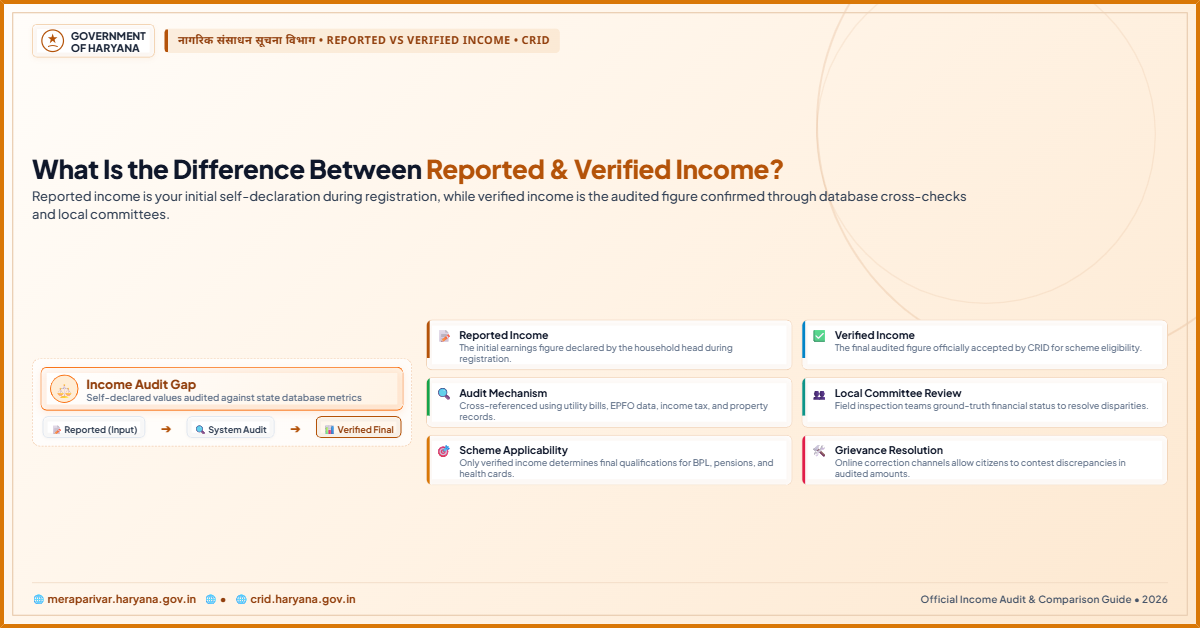
Quick Answer : Reported income is the self-declared figure you enter on PPP Haryana at registration. Verified income is the audited amount confirmed by Local Committees or digital checks and stored in FIDR. Only verified income in your Family Income & Profile decides scheme eligibility and your Chirayu premium slab.
What Is Reported Family Income?
Reported family income is the figure a household enters into the Parivar Pehchan Patra portal during registration or self-update. It is a self-declaration. No officer checks it before it appears on your Family ID slip.
The official PPP Data Policy confirms that annual income is collected “on self-declaration basis,” with no requirement to disclose income sources at this stage.
This keeps registration simple, but it also means the first figure on your profile is only a claim—not proof. Reported income can be too high or too low. A family may under-report to qualify for subsidies, or over-report because they misunderstood the form. Either way, the portal records what was typed, not what is true.
What Is Verified Family Income?
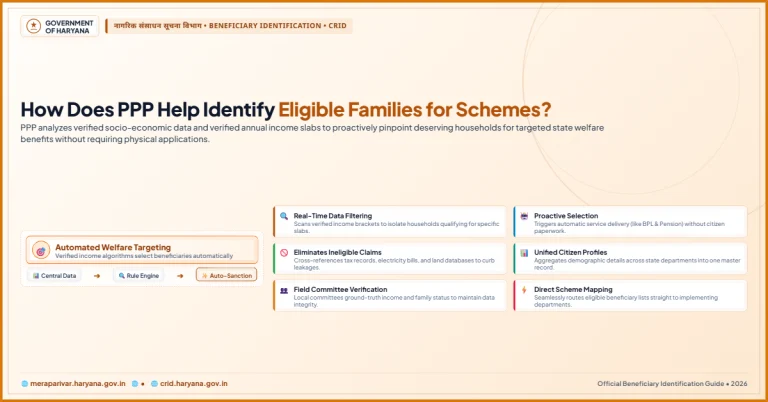
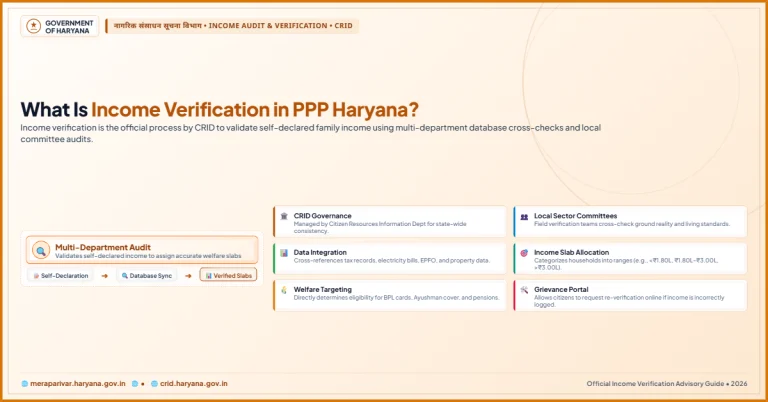
Verified family income is the audited amount stored in the Family Information Data Repository (FIDR) after an official review. It is the figure the state trusts for eligibility decisions.
Haryana’s official process defines verified income in FIDR as the amount that matches Local Committee inputs or electronic verification.
Verification runs through two channels. Digital checks compare declared income against Income Tax records, government employee databases (HRMS), and Haryana Labour Welfare Board data.
Where digital matching fails, a Local Committee (LC) conducts field verification.
How Do Reported and Verified Income Differ?
| Feature | Reported Family Income | Verified Family Income |
|---|---|---|
| Definition | Self-declared figure entered by the household | Audited figure confirmed in FIDR |
| Who provides it | Citizen or family member | Local Committee or digital cross-check |
| Source of truth | Registration form | Employment, tax, and field records |
| Validity | Temporary; not accepted for certificates | Required for income certificates and most schemes |
| Used for | Starting the registration process | Approving welfare benefits and Chirayu slabs |
Reported income is a starting point. Verified income is a decision point. One is a claim; the other is a conclusion.
Why the Difference Matters for Welfare Schemes
Haryana links more than 400 schemes across over 50 departments to the PPP database. Many schemes set income ceilings.
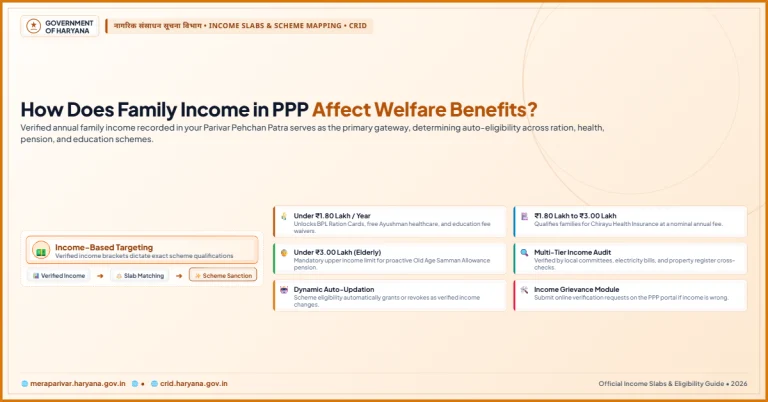
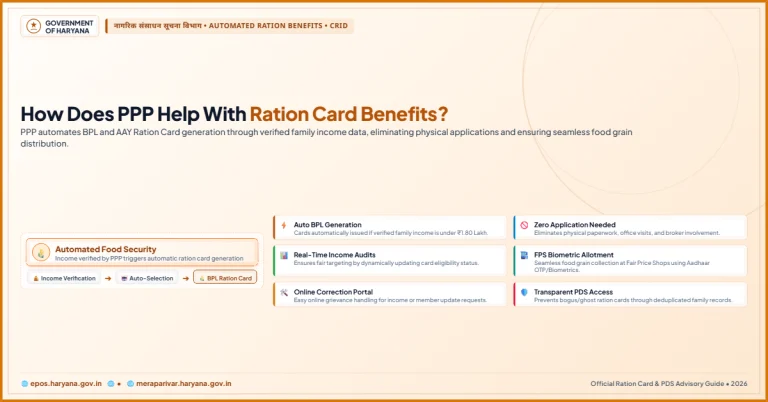
Families with verified annual income up to ₹1.80 lakh are treated as BPL for ration cards and core welfare benefits. Eligibility is checked against verified income, not reported income.
A mismatch creates two problems. If reported income is lower than verified income, the system flags the gap, and benefits can stop or be denied.
If reported income lingers unverified, a genuinely eligible family remains stuck outside the scheme.
The Expanded Chirayu Health Cover: Slabs Up to and Above ₹6 Lakh
The ₹1.80 lakh line is no longer the top of the Chirayu ladder. The Haryana government has expanded the Chirayu Ayushman Bharat scheme to cover middle- and higher-income families through a tiered premium structure based on verified PPP income.
The expansion took effect from 1 November 2026, following a health department notification dated 13 October 2026.
| Verified Annual Family Income | Annual Chirayu Contribution |
|---|---|
| Up to ₹1.80 lakh | Covered under BPL framework |
| ₹1.80 lakh to ₹3 lakh | ₹1,500 per family |
| ₹3 lakh to ₹6 lakh | ₹4,000 per family |
| Above ₹6 lakh | ₹5,000 per family |
The scheme provides ₹5 lakh annual cashless treatment at empanelled public and private hospitals across India, with national portability and 2,694 medical, surgical, and day-care packages.
Enrolment and premium payment run through the official portal at chirayuayushmanharyana.in, and beneficiary cards are valid from 1 November to 31 October each year.
Eligibility is verified strictly through the PPP database—not through self-declared figures.
The Agricultural Data Cushion for Farming Households
For farming households, the state has addressed a specific trap. Large gross crop-sale figures on the Meri Fasal Mera Byora portal can inflate apparent income.
The government has directed that the entire gross value of electronic crop procurement should not be blindly treated as net household income, ensuring that small farmers are not unfairly pushed past the ₹1.80 lakh threshold by procurement totals alone.
How Verified PPP Data Feeds Income Certificates
Verified income also produces income certificates. Haryana issues these certificates through the SARAL portal based on verified data in FIDR.
The certificate is digitally authorised through the Citizen Resources Information Department (CRID) infrastructure and facsimile-signed by the ADC-cum-DCRIO. The CRID backend pushes the digitally signed certificate—not a local registry signature. A reported figure alone cannot produce that certificate.
How to Check Your Family Income Status
Step 1: Open the Official PPP Haryana Portal
Go to meraparivar.haryana.gov.in in your browser. This is the official portal for Parivar Pehchan Patra services.
Step 2: Log In With Your Family ID
Enter your PPP number or your registered Aadhaar number in the login field.
Step 3: Enter the OTP
Type the one-time password sent to your registered mobile number. This confirms your identity before the dashboard opens.
Step 4: Open Your Family Dashboard
Navigate to the income section of your Family Income & Profile.
Step 5: Read the Status Label
Check whether the portal shows “Verified” or “Unverified” next to your income figure. This single word decides scheme eligibility and your Chirayu premium slab.
Step 6: Compare the Displayed Amount
Match the figure on screen with your actual household earnings. A mismatch means either a data entry error or a pending audit.
Step 7: Note Any Mismatch
Write down the difference before you file a request. This helps you explain the issue clearly.
How to Correct or Verify Family Income
Step 1: Log In and Open the Correction Module
Log in to the main Mera Parivar Portal at meraparivar.haryana.gov.in. On your family dashboard, click directly on the “Correction Module” tab. Do not search for a separate external grievance link—the correction route sits inside your own dashboard.
Step 2: Select the Correction Type
Choose the income correction or re-verification option from the available update types. This flags the specific field that needs review.
Step 3: Upload Proof if Asked
Attach a salary slip, bank statement, or employer letter if the portal requests evidence. Clear documents speed up committee review.
Step 4: Submit the Request
Review the entered details, submit the correction request, and complete OTP verification if prompted. Note the reference number for tracking.
Step 5: Wait for Local Committee Review or a Gram Sabha Camp
Your request goes to the Local Committee members responsible for your area. Verification delays can now be resolved on the spot during Gram Sabha verification camps organised by the district administration. The state has directed CRID to complete pending income verification through Gram Sabhas, and the decision taken by the Gram Sabha is treated as final for the family’s income figure.
Step 6: Watch for the FIDR Update and SMS
If the data matches, the portal marks your income as “VERIFIED” in the Family Information Data Repository and sends an SMS confirmation.
Step 7: Follow Up Through the Portal
If no update appears, track the reference number through the same dashboard. Do not file a duplicate request.
Conclusion
Reported income only opens your PPP registration. Verified income opens welfare schemes, the correct Chirayu slab, and income certificates. So check your Family Income & Profile status, fix any mismatch through the dashboard’s Correction Module, and let verification—not your declaration—decide what you receive.
Frequently Asked Questions
Can I use reported income to get an income certificate?
No. Haryana issues income certificates only on the basis of verified data in FIDR through the SARAL portal, digitally authorised through CRID.
Does the ₹1.80 lakh limit apply to Chirayu health cover?
No, not as a ceiling. Chirayu now covers verified income up to and above ₹6 lakh through tiered premiums: ₹1,500 for ₹1.80–3 lakh, ₹4,000 for ₹3–6 lakh, and ₹5,000 above ₹6 lakh.
Will crop-sale data on Meri Fasal Mera Byora push my family above the income limit?
For farming households, the state has directed that gross electronic crop procurement should not be blindly treated as net household income, preventing small farmers from being unfairly pushed past the ₹1.80 lakh threshold.
How long does verification take?
The official standard sets a seven-day timeline for the Local Committee income verification step. Gram Sabha camps can shorten the wait by resolving cases in person.
Can I correct my income without visiting an office?
Yes. The Correction Module inside your Mera Parivar dashboard lets you submit changes online. The updated figure still needs verification before it counts for scheme eligibility or changes your Chirayu slab.
What if my Family ID shows a different income than what I declared?
The verified figure may have been set by Local Committee inputs or digital matching. If you disagree, use the correction module to contest it with evidence.