How Is Family Income Recorded in PPP Haryana?
Wrong income details on your PPP Haryana Family record can block ration cards and pensions. The system starts with self-declaration, but field audits by CPLOs and LCLOs, Gram Sabha checks, and digital database matching decide what stays.
Quick Answer : Family Income & Profile in PPP Haryana is self-declared by the family head, then verified through Local Committee field audits (led by CPLOs and LCLOs), Gram Sabha confirmation, Sector Committee review, and automatic matching with tax, electricity, property, and employment databases.
What Family Income Means Inside Parivar Pehchan Patra
Parivar Pehchan Patra is Haryana’s household identity system. Each family gets an eight-digit Family ID holding member names, occupations, and a Family Income range.
Over 77 lakh families and nearly 3 crore members are registered across Haryana’s 23 districts. More than 50 departments use PPP data to run over 400 schemes.
The head of the family declares income first. That declaration is a claim, not a verified fact.
How Income Slabs Are Grouped
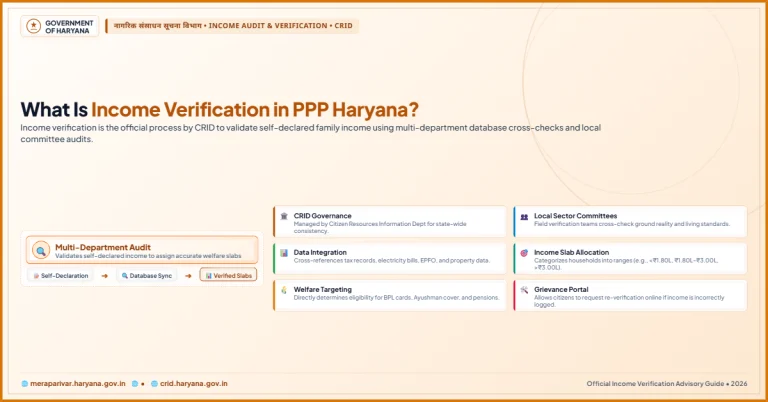
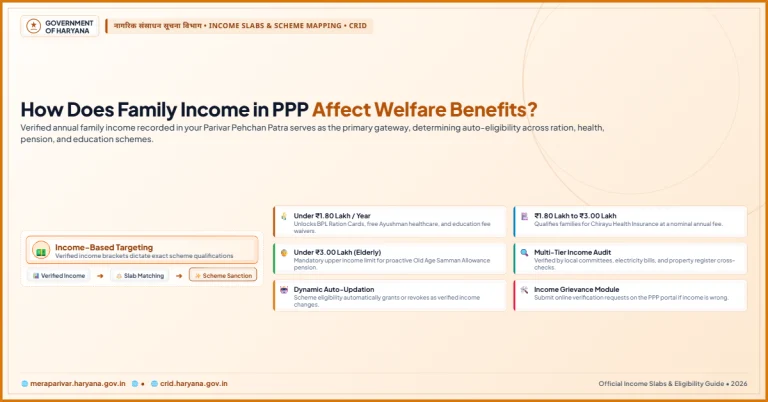
CRID places households into ranges. The key threshold is ₹1.80 lakh per year. Families below this line qualify as BPL for yellow ration cards, pensions, and health cover.
Agricultural income up to ₹5 lakh does not automatically push a family above the ₹1.80 lakh BPL ceiling.
Note on single-member families: Under recent directives, households registered as a Single-Member Family ID face a specific restriction.
Their yellow (BPL) ration cards are cancelled. Single individuals should confirm their family ID status before applying for BPL benefits.
| Income Range | Main Effect |
|---|---|
| Below ₹1.80 lakh | BPL ration card, pensions, health cover |
| Above ₹1.80 lakh | Non-BPL schemes; some subsidies taper off |
Step-by-Step: How PPP Haryana Verifies Family Income
Verification runs through several layers before a Family Income range is locked as verified in the Family Information Data Repository (FIDR) .
Step 1: Self-Declaration by the Family Head
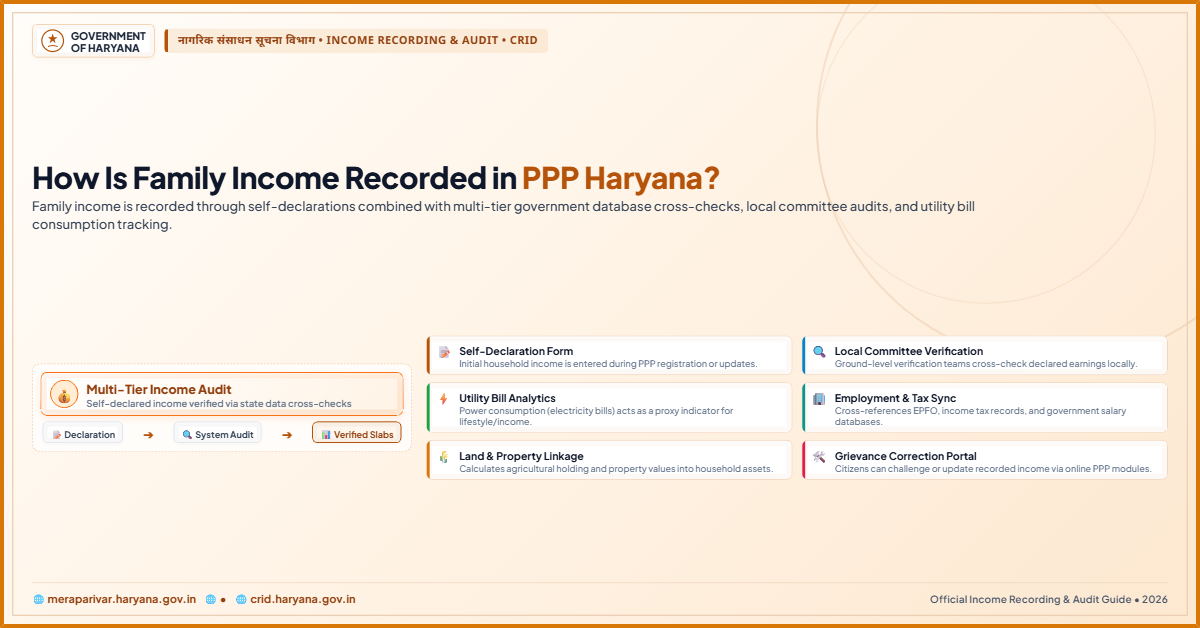
The head enters each member’s annual earnings on the Mera Parivar portal. This creates the first record. It is treated as a claim.
Step 2: Field Audit by Local Committee
A Local Committee conducts spot checks. CPLOs (CRID Panchayat Local Operators) and LCLOs (Local Committee Local Operators) handle the field-level data entry and verification.
The team lead is a government employee, and the committee includes a volunteer.
Step 3: Gram Sabha Confirmation
Income figures prepared by the CPLO and LCLO are placed before the Gram Sabha. The Gram Sabha’s decision on actual family income is final.
Step 4: Sector Committee Review
If a family disputes a Local Committee finding, a Sector Committee reviews the case. This second-level check catches discrepancies between field reports.
Step 5: Digital Cross-Matching
The portal compares declared income with external records. These include Income Tax Returns, government payroll data, electricity bills from DISCOMs, property registrations, GST/EPFO records, and agricultural procurement payments. A high bill or a tax return can upgrade the income range even if the family declared less.
Step 6: Final Locking in FIDR
Once checks are complete, the verified range is locked in FIDR. Departments read that range to decide eligibility. A verified field can be accepted as conclusive proof without fresh documents.
How to Correct or Update Family Income
If the recorded slab is wrong, the Correction Module on the official portal is the primary route. Citizens who cannot use the portal alone can use Assisted Mode at a CSC or SARAL Kendra.
Step-by-Step: Filing an Income Correction
Step 1: Log in to the official portal
Visit meraparivar.haryana.gov.in or ppp-office.haryana.gov.in . Enter your Family ID and complete OTP verification on your registered mobile number.
Step 2: Open the Correction Module
On the dashboard, go to the “Family Details” tab. Click “Update Family Details” or “Correction Module” .
Step 3: Choose Income Correction
Select the family member whose income needs revision. Choose “Income” as the field to correct.
Step 4: Enter correct details and upload proof
Enter the accurate annual income. Upload supporting documents such as a bank statement (last 6 months) , salary slips, or ITR acknowledgement.
Step 5: Submit and save the reference number
Review all details. Submit the request and complete OTP verification if prompted. Save the reference number to track the application.
Step 6: Wait for field re-verification
A Local Committee officer will re-verify the claim on-site. The updated range appears in FIDR only after committee sign-off.
Assisted Mode: Citizens who cannot complete the online steps independently can visit the nearest CSC, SARAL Kendra, or PPP Operator. The operator edits the details on their behalf through the same Correction Module.
| Identity | Aadhaar card, Voter ID |
|---|---|
| Earnings proof | Bank statement (6 months), salary slips, ITR |
| Occupation proof | Employer certificate, labour card, land record |
| Document Type | Accepted Examples |
|---|---|
| Identity | Aadhaar card, Voter ID |
| Earnings proof | Bank statement (6 months), salary slips, ITR |
| Occupation proof | Employer certificate, labour card, land record |
What Happens When Income Is Recorded Incorrectly
Inaccurate income can remove a household from BPL benefits. In April 2025, Haryana flagged 6.84 lakh families for allegedly false declarations in PPP and gave them a deadline to correct records.
The verification system balances fast welfare delivery against misuse.
Conclusion
Recording Family Income in PPP Haryana is a chain. Self-declaration opens it. CPLOs, LCLOs, Gram Sabhas, Sector Committees, and digital matching close it.
If your income range looks wrong, use the Correction Module early or visit a CSC/SARAL Kendra for assisted help.
Frequently Asked Questions
1. Who verifies family income in PPP Haryana?
CPLOs and LCLOs handle field audits. Gram Sabhas confirm village-level figures. Sector Committees review disputes.
2. What is the BPL income limit under PPP Haryana?
Verified annual household income below ₹1.80 lakh is treated as BPL. Agricultural income up to ₹5 lakh does not automatically disqualify a family.
3. Can single-member families get a yellow ration card?
No. Households registered as a Single-Member Family ID face cancellation of their yellow (BPL) ration card under recent directives.
4. How long does an income correction take?
Simple cases may resolve in 7–15 working days. Complex slab disputes that loop through the ADC office routinely take up to 30 days to refresh in FIDR.
5. Can I lower my income without documents?
No. Any reduction requires physical verification by a Local Committee and supporting proof.
6. Where can I check my verified income?
Log in to the Mera Parivar portal with your Family ID and OTP. The dashboard shows your current verified range.