Which Haryana Government Schemes Use Family ID Information?
Missing welfare benefits in Haryana often starts with one small gap: an outdated PPP Haryana Family record. When your household details do not match government databases, pensions stop, hospital bills pile up, and scholarship money stays stuck. The Family ID is now the single key that opens most state welfare doors.
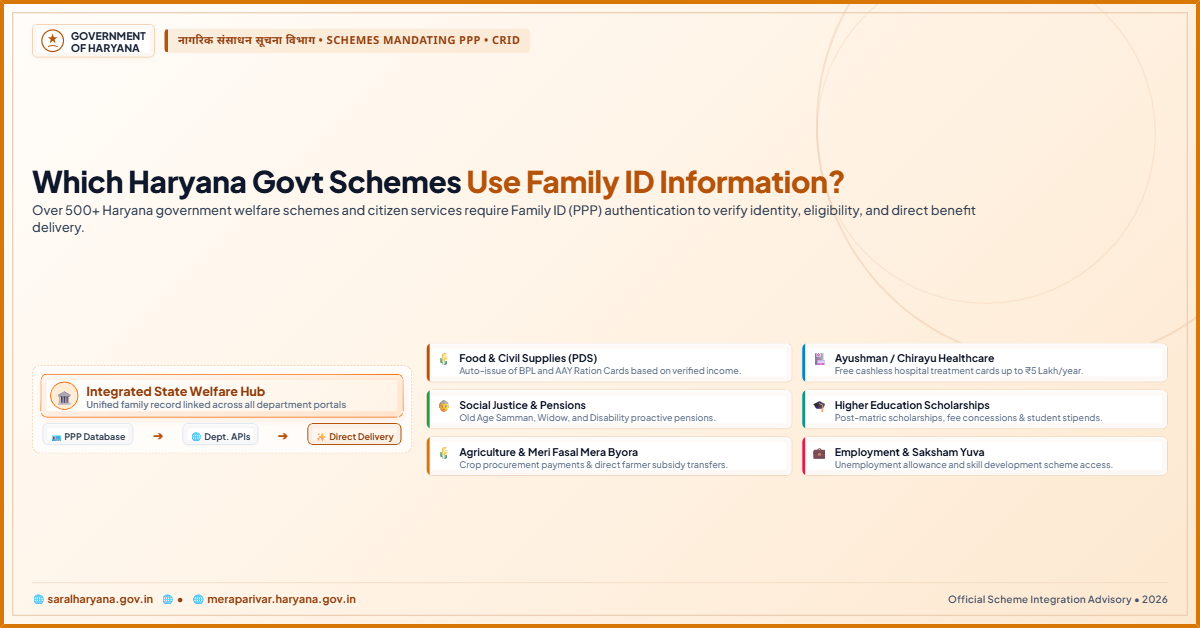
Quick Answer : The PPP Benefits & Schemes network uses Family ID data for Old Age Samman Allowance, Widow and Destitute Women Pension, Divyang Pension, Chirayu Ayushman Bharat health cover, BPL and AAY ration cards, Mukhyamantri Vivah Shagun Yojana, Saksham Yuva allowance, and post-matric scholarships. Verified household income in the Parivar Pehchan Patra decides who qualifies and who does not.
How the Family ID Becomes Your Welfare Key
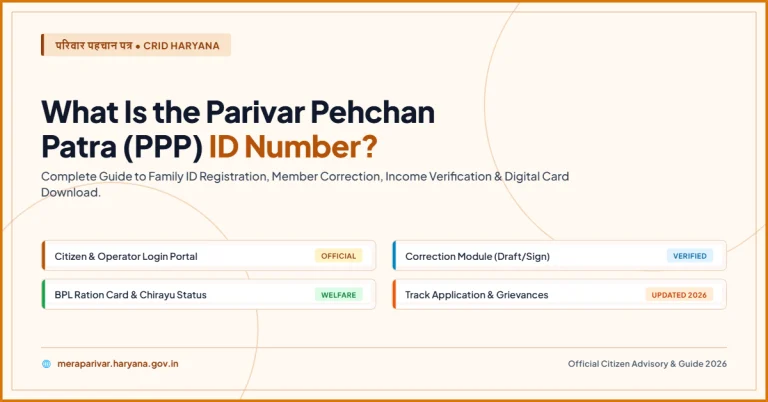
The Parivar Pehchan Patra (PPP) is a family-level identity system run under the Haryana Parivar Pehchan Act, 2021.
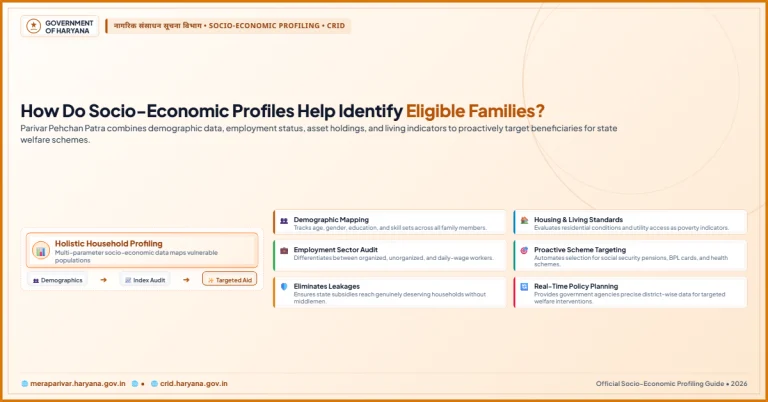
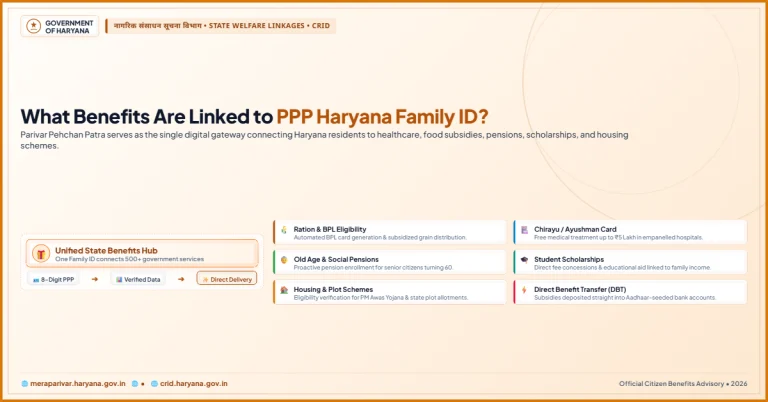
Each permanent resident family receives an 8-digit Family ID, while temporary resident families get a 9-digit ID starting with “T”. The Citizen Resources Information Department (CRID) maintains the Family Information Data Repository that stores income, age, caste, occupation, and bank details.
Government departments do not ask for separate income certificates for every scheme. They query this one database and run automated eligibility checks.
Once your data is verified, the system can select you for benefits without a fresh application for each programme. As of 2026, more than 77 lakh families and nearly 3 crore individuals are registered on the PPP platform across Haryana’s 23 districts.
Social Security Pensions That Depend on Family ID
The Social Justice and Empowerment Department integrated three pension schemes with PPP in 2020. These are the clearest examples of automatic Family ID-based welfare.
- Old Age Samman Allowance: Residents aged 60 and above receive monthly financial aid. The PPP database flags qualifying individuals using birth records and Aadhaar data, so many beneficiaries are enrolled without a separate pension application.
- Widow and Destitute Women Pension: Widows and unmarried women in low-income households get monthly security. The family profile must show the correct marital status and income bracket.
- Divyang Pension: Persons with permanent disabilities receive a monthly stipend when their verified medical board certificate is linked to the family profile.
If a family member’s age, marital status, or disability status is wrong on PPP, the pension stops or never starts. The department does not accept standalone paper claims as the primary proof anymore.
Health and Food Schemes Linked to PPP Data
Two of Haryana’s largest welfare programmes pull eligibility directly from Family ID records.
Chirayu Ayushman Bharat
Families with verified annual income up to ₹1.80 lakh get free cashless treatment up to ₹5 lakh per family per year at empanelled hospitals.
In 2026, the scheme expanded to higher-income families who pay a graded annual premium: ₹1,500 for income between ₹1.80 lakh and ₹3 lakh, and a premium of ₹5,000 per year for families with a verified income between ₹3 lakh and ₹6 lakh.
Currently, the subsidized health cover extension caps off at the ₹6 lakh annual income bracket. The premium slab is fixed by the income figure recorded in the Parivar Pehchan Patra, not by a separate declaration.
BPL and AAY Ration Cards
The Food, Civil Supplies and Consumer Affairs Department issues Yellow (BPL) and Pink (AAY) ration cards after checking household income in PPP. When verified annual earnings fall below the state poverty threshold, the portal generates a digital ration card. Families then collect subsidised wheat, sugar, and mustard oil from Fair Price Shops through biometric verification.
In December 2022, Haryana discontinued 9,60,235 yellow ration cards after PPP verification showed those families were above the income limit. That single example shows how closely food security is tied to Family ID accuracy.
Education, Marriage, and Employment Schemes Using Family ID
Several direct benefit transfer (DBT) programmes rely on PPP income data to approve or reject applications.
Mukhyamantri Vivah Shagun Yojana
This scheme gives a marriage grant to daughters of low-income families. The amount depends on category and verified income.
Scheduled Caste, Vimukt Jati, and Tapriwas families with annual income up to ₹1.80 lakh receive ₹71,000; Backward Class and General category families with income up to ₹1.80 lakh receive ₹41,000; widows of any category with income below ₹1 lakh receive ₹51,000.
The application must be filed within six months of marriage, and the family income shown in PPP is the first check.
Saksham Yuva Scheme
Unemployed educated youth can receive a monthly allowance plus honorarium for work. The annual family income limit is ₹3 lakh, and the figure is read from the PPP record. Applicants with income above ₹3 lakh in the Family ID are rejected at the verification stage, even if they have a separate income certificate.
Scholarships and Education Support
Post-Matric and Pre-Matric Scholarships for Scheduled Castes, Backward Classes, and economically weaker sections use PPP data to verify caste, income, and family size. Free bicycle distribution and the Nihshulk Pathya Pustak Yojana also check BPL status in the family profile before releasing benefits.
Schemes That Use Family ID: Quick Comparison
| Scheme | Who It Serves | Family ID Data Used | Main Benefit |
| Old Age Samman Allowance | Residents aged 60+ | Age, income, bank details | Monthly pension |
| Widow and Destitute Women Pension | Widows, destitute women | Marital status, income | Monthly pension |
| Chirayu Ayushman Bharat | Low and middle-income families | Verified annual income | Up to ₹5 lakh cashless hospital care (Free under ₹1.80L income; graded annual premium of ₹1,500 or ₹5,000 for families up to ₹6L) |
| BPL/AAY Ration Card | Below-poverty-line households | Income, family size | Subsidised food grains |
| Mukhyamantri Vivah Shagun Yojana | Daughters of low-income families | Income, caste, marriage proof | ₹41,000 to ₹71,000 grant |
| Saksham Yuva | Unemployed educated youth | Family income, education | Monthly allowance plus honorarium |
Steps to Check Which Schemes Your Family ID Unlocks
I split the old checklist into three stages. Each stage has one clear goal, so you can stop and check your progress before moving ahead.
Stage 1: Open the Portal and Log In
- Open the official PPP website. Type meraparivar.haryana.gov.in into the address bar. Use Chrome or Edge on a stable connection.
- Choose Citizen Corner. Select “Update Family Details” or the scheme eligibility view. Do not use third-party links.
- Log in with your Family ID or Aadhaar. Enter the 8-digit Family ID, then enter the OTP sent to your registered mobile number.
My added tip: Keep your Aadhaar-linked mobile in hand before you log in. A mobile number mismatch is one of the most common reasons people cannot open their scheme cards.
Stage 2: Read the Dashboard Like a Checklist
- Check the income bracket first. This single figure decides Chirayu premium, Saksham Yuva eligibility, and many scholarships.
- Match every member’s age and marital status. One wrong age can stop an Old Age or Widow pension.
- Confirm caste and occupation entries. Scholarship and marriage grant approvals depend on these fields.
- Verify bank account seeding. The account must be in the beneficiary’s name and linked to Aadhaar for direct benefit transfer.
My added tip: Take a screenshot of the dashboard before you change anything. It gives you a dated record of what the system showed on that day.
Stage 3: Fix Errors and Track the Request
- Upload proof only for the field that is wrong. Use an income certificate for income, a birth record for age, and a caste certificate for caste.
- Write a short reason in the correction box. Example: “Income changed after new salary slip; certificate attached.”
- Save the request reference number. You will need it for follow-up.
- Check status after 7 days. Most document-backed corrections close in 7 to 15 working days after local verification.
Why an Updated Family ID Matters
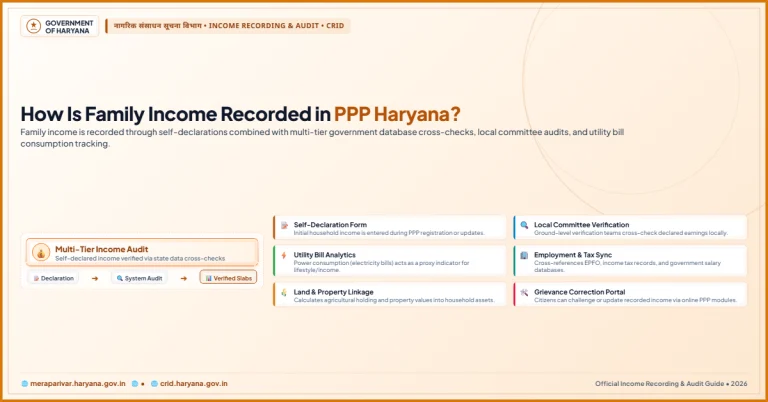
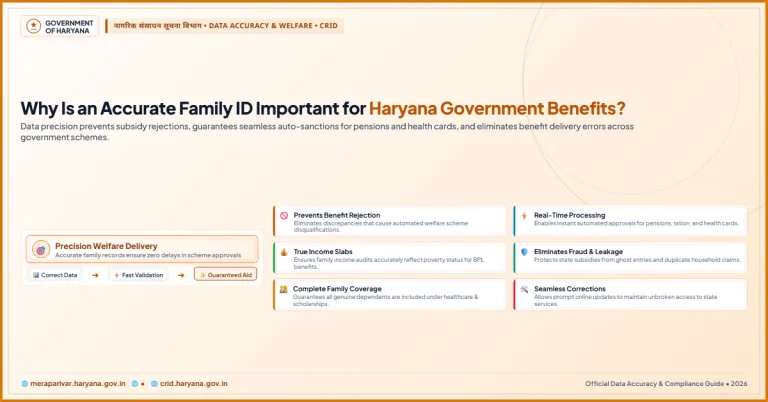
A wrong income entry can block a pension, reject a scholarship, or cancel a ration card. A correct entry can trigger automatic approval without repeated office visits. The PPP system removes middlemen and sends DBT payments straight to verified bank accounts.
Real-time income updates also prevent ineligible households from claiming funds meant for low-income residents. Keeping the Family ID accurate is not paperwork; it is the difference between receiving and losing your welfare entitlement.
Conclusion
Haryana’s welfare system now runs on one shared household record. Pensions, Chirayu health cover, ration cards, marriage grants, youth allowances, and scholarships all read the same PPP Haryana Family data. If you know which schemes use Family ID information, you can check your profile once and unlock multiple benefits at the same time.
Frequently Asked Questions
1. Is Family ID mandatory for all Haryana government schemes?
It is mandatory for almost all state welfare programmes, including pensions, ration cards, Chirayu, scholarships, and Saksham Yuva.
2. What should I do if my income is wrongly verified in the Family ID?
You must log into the Mera Parivar portal and file an “Income Grievance.” Local sector committees will re-verify your physical economic status. Once approved, your income bracket will adjust, automatically restoring or unlocking eligible schemes.
3. Can a temporary resident get a Family ID for Haryana schemes?
Yes. Temporary residents receive a 9-digit ID starting with “T” and can access services linked to their temporary family profile.
4. Do I need a separate scholarship application if I have a Family ID?
Yes, you must apply on the scholarship portal, but the system auto-fills income and personal details from your Family ID.
5. How long does a Family ID correction take?
Document-backed corrections usually take 7 to 15 working days after local authority verification.
6. What happens if I ignore a wrong income entry on PPP?
Your pension, ration card, or Chirayu cover can be stopped or rejected automatically because departments read the same Family ID data.