How Does Socio-Economic Information Help Haryana Identify Eligible Families?
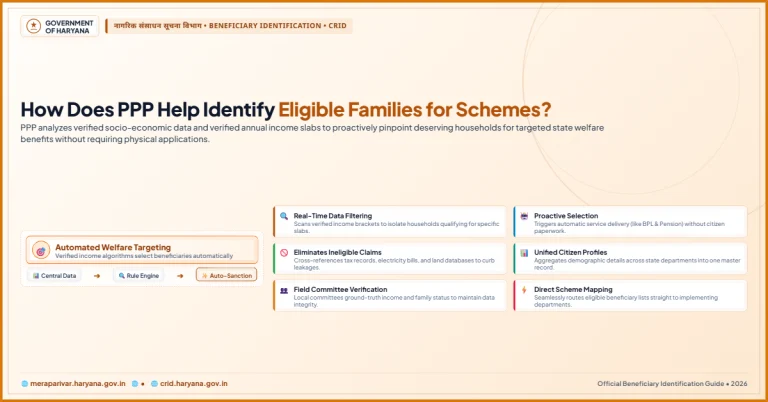
Struggling to prove your household qualifies for Haryana welfare benefits? The PPP Haryana Family system uses verified socio-economic data—income, occupation, and profile—to match families with schemes they truly deserve. No repeated paperwork. No middlemen. Just accurate eligibility checks.
Quick Answer : Family Income & Profile data powers PPP Haryana Family eligibility checks. The state matches household earnings, occupation, land ownership, and age records against scheme rules, so verified families receive pensions, rations, and subsidies without repeated paperwork.
Why Household Data Matters for Welfare Delivery
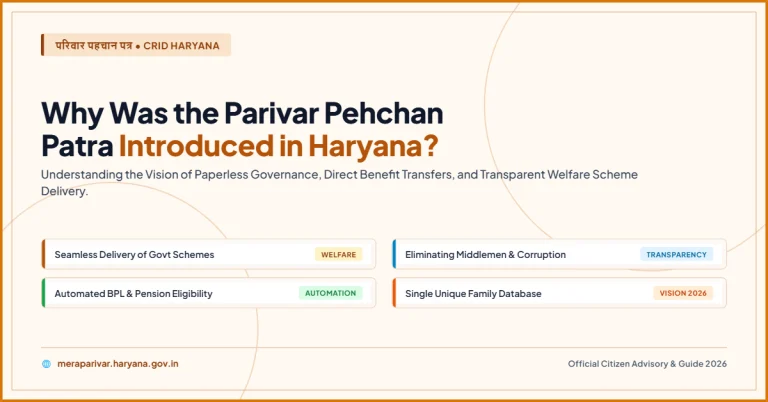
Welfare schemes fail when governments cannot tell who is genuinely poor. Duplicate claims, ghost beneficiaries, and outdated records drain public money. Haryana’s Parivar Pehchan Patra (PPP) fixes this by building one verified family profile for every household in the state.
The PPP assigns each family an eight-digit Family ID. This ID links birth, death, and marriage records, so household data updates automatically when life events occur. As of May 2026, 77,41,912 families and 2,98,47,359 members across all 23 districts are registered on the platform.
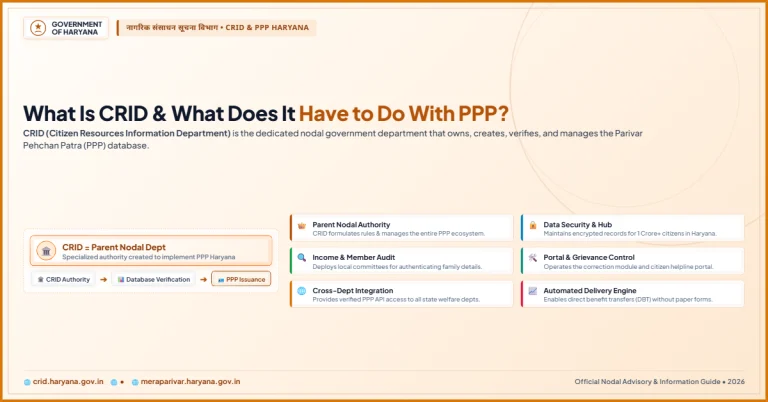
More than 50 government departments connect to PPP, running over 400 schemes through the system. The platform replaces repeated document submissions with a single, verified household profile.
How Socio-Economic Indicators Drive Eligibility
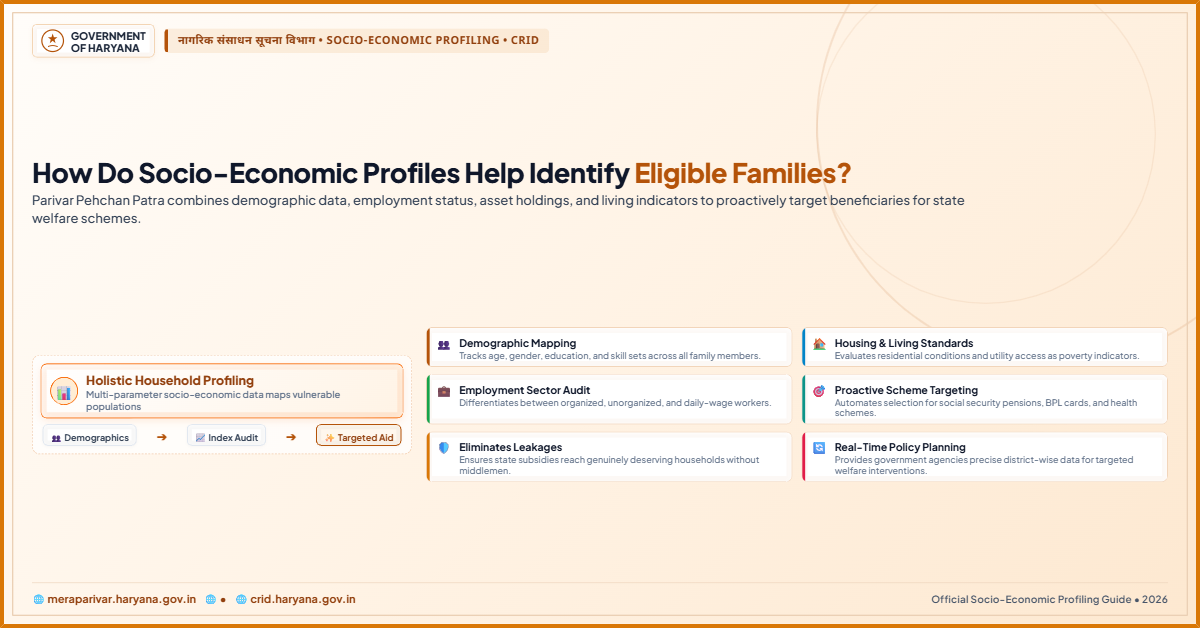
The PPP database captures more than names and addresses. It records annual income, caste, disability status, land holdings, and occupation for every member. Different schemes apply different thresholds to these data points.
| Data Indicator | What It Determines | Real-World Benefit |
|---|---|---|
| Annual family income | Below Poverty Line (BPL) status | BPL ration cards, fee waivers, Chirayu Ayushman cover |
| Occupation type | Labour and farmer support eligibility | Direct benefit transfers for agricultural workers |
| Land ownership | Asset-based exclusion rules | Prevents large landowners from claiming small-family benefits |
| Age and disability records | Pension and allowance triggers | Old Age Samman, widow pension, disability pension |
| Residential status | State domicile verification | Restricts state-funded schemes to genuine Haryana residents |
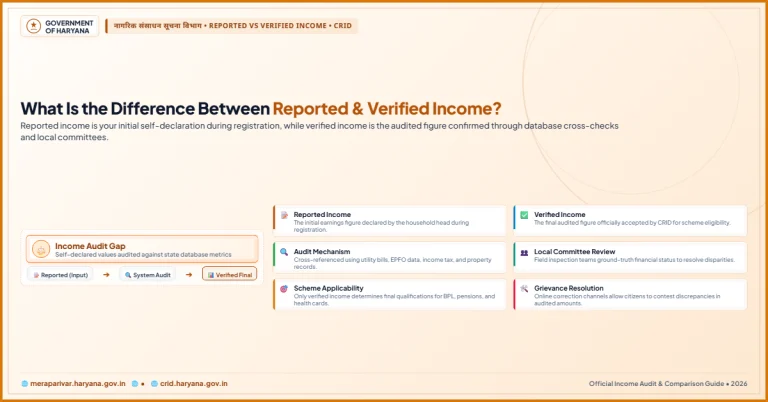
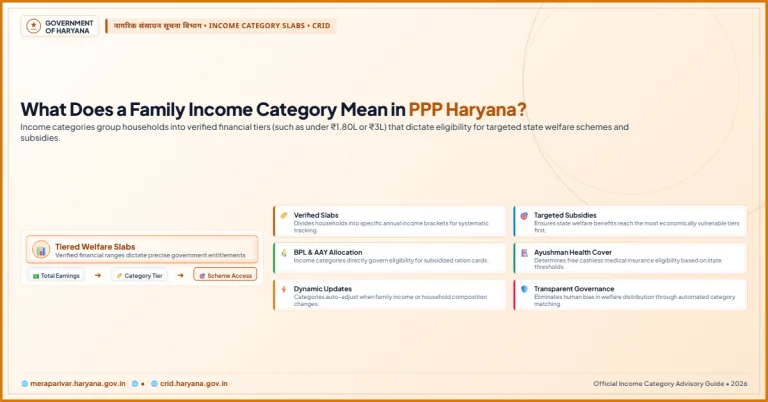
Income is the heaviest-weighted factor. Families with verified annual income below ₹1.80 lakh are treated as BPL households and receive scheme benefits automatically. The PPP does not ask for bank details or income sources at registration—only a self-declared annual figure, which is later verified.
Agricultural income does not disqualify a family. The Chief Minister has directed that no household should lose benefits meant for the ₹1.80 lakh income group merely because it earns up to ₹5 lakh from farming.
The Verification Process: From Self-Declaration to Ground Truth
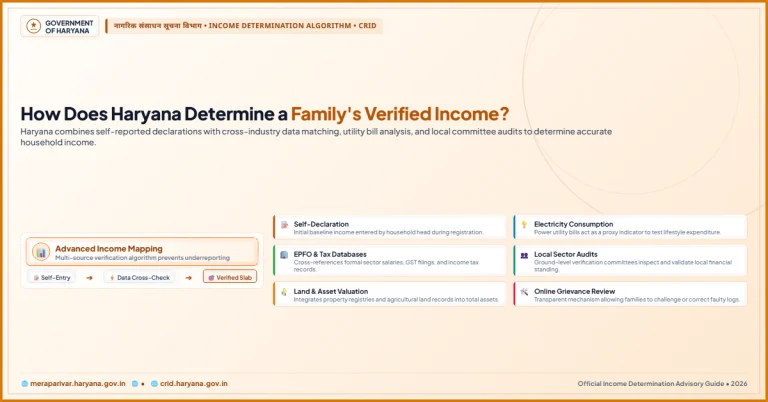
Self-declared income alone cannot be trusted. Haryana cross-checks every family’s declaration against independent databases, including Income Tax records, government payroll data, pension databases, industrial wage records, crop procurement data, and electricity consumption patterns.
When electronic checks are inconclusive, Local Committees step in. Each committee includes a government team lead, a local operator, and a volunteer.Members assess income separately, but their reports often disagree on the actual figure.
To break the deadlock, the Chief Minister directed in May 2026 that disputed income figures be placed before the Gram Sabha of the concerned village. The Gram Sabha verifies the family’s actual income, and its decision is treated as final.
Verification has already removed ineligible beneficiaries. In December 2022, yellow ration cards were discontinued for 9,60,235 families after income checks showed they did not qualify.
In April 2025, 6.84 lakh families came under scrutiny for allegedly false income declarations and artificial family splits, with the government sending text messages on April 3, 2025, and setting a deadline of April 20, 2025 to correct records before legal action or benefit recovery. Sirsa and Hisar recorded the highest number of flagged families.
Families can challenge outcomes through the Correction and Grievance portals. Every exclusion challenge moves electronically to a higher review committee.
How to Register Your Family and Maintain an Accurate Profile
Eligibility depends on accurate data. Registration is free—the government pays operators directly. Keep these steps short and precise.
Step 1: Gather Your Documents
Collect Aadhaar cards for all members, the family head’s Aadhaar-linked mobile number, address proof such as an electricity bill, birth proof (birth certificate or matriculation certificate), and Voter ID for adults.
Step 2: Visit a Registration Point
Go to a Common Service Center (CSC), an Antyodaya Saral Kendra, or a registered PPP operator.
Step 3: Declare Income and Occupation
State your family’s total annual income and primary occupation. No bank statements or income-source proof needed at this stage.
Step 4: Check and Submit
Review every printed detail for spelling and date errors. Submit the form and keep your reference number.
Step 5: Track Verification and Download Your ID
Use the Mera Parivar portal (meraparivar.haryana.gov.in) with your registered mobile number. Once the Citizen Resource Information Department (CRID) approves the profile, download your digital Family ID card.
Step 6: Update Life Events Promptly
Report births, deaths, marriages, and income changes through the Update Family Details tab or at a service center. Automatic civil-registry sync handles many events, but manual updates keep the profile accurate between syncs.
How to Fix Common PPP Profile Errors
Wrong data can silently block benefits. Here is the short version of what to correct and where.
| Error | What It Blocks | Where to Fix |
|---|---|---|
| Income wrongly above ₹1.80 lakh | BPL cards, Chirayu Ayushman | Correction tab on Mera Parivar |
| Wrong occupation entry | Labour and farmer schemes | CSC or Saral Kendra |
| Aadhaar name mismatch | All scheme verifications | PPP operator |
| Wrong bank or IFSC details | DBT payments, pensions | Self-service portal |
| Split Family IDs | Household benefits, legal risk | Correction module, then committee review |
| Deceased member still listed | Income-per-member screening | Update Family Details tab |
Log in to the Mera Parivar portal and open the Correction tab for self-service edits. For Aadhaar-related or structural changes, visit a CSC or Antyodaya Saral Kendra.
After submission, CRID reviews the request and updates your profile across every connected department. Rejected corrections can be escalated through the Grievance route to a higher committee.
Conclusion
Socio-economic data turns welfare from guesswork into a verified process. Haryana’s PPP uses Family Income & Profile records to separate genuine need from false claims, routing pensions, rations, and subsidies to the households that qualify. Accurate self-declarations and timely updates keep the system fair for everyone.
Frequently Asked Questions
1. What is a PPP Family ID?
An eight-digit unique number assigned to every registered household in Haryana, linking all members to state welfare databases.
2. Is PPP registration mandatory for welfare schemes?
Yes. Most Haryana state schemes require a Family ID for eligibility verification and benefit delivery.
3. How does the government verify my income?
Through digital cross-checks with Income Tax, payroll, pension, and electricity databases, plus Local Committee and Gram Sabha assessments.
4. Can I update my income after registration?
Yes. Use the Mera Parivar portal’s Update Family Details tab or visit a CSC to revise income and household information.
5. Which schemes use PPP data for eligibility?
Over 400 schemes run by more than 50 departments, including old-age pensions, widow pensions, ration cards, Chirayu Ayushman, and agricultural support programs.
6. What if my family is wrongly excluded from a scheme?
File a challenge through the Correction or Grievance portal. Exclusions are reviewed electronically by higher committees.