A wrong income figure on your PPP Haryana Family record can quietly cut off your ration card, pension or hospital cover. The Parivar Pehchan Patra ties every household’s verified earnings to state benefits. Knowing how that number is set—and how to fix it—protects your family’s access.
Quick Answer : The PPP Haryana Family ID is an 8-digit household number. It maps a family’s verified annual income to state welfare. Families up to ₹1.80 lakh get BPL ration cards and free Chirayu cover. Income is checked against tax records, e-procurement data and Gram Sabha verification before benefits start.
What Is the Parivar Pehchan Patra?
The Parivar Pehchan Patra gives every registered family in Haryana an 8-digit Family ID. Aadhaar identifies one person. PPP treats the whole household as a single economic unit.
The Citizen Resources Information Department (CRID) runs the database. The Haryana Parivar Pehchan Authority governs it under the Haryana Parivar Pehchan Act, 2021.
Permanent residents hold the 8-digit ID. Temporary IDs go to non-resident families applying for Haryana services.
As of May 2026, 77,41,912 families and 2,98,47,359 members are registered across all 23 districts, including Hansi, which became the 23rd district on 22 December 2025. More than 50 departments and over 400 schemes are linked to PPP.
How PPP Haryana Family Income Verification Works
A self-declared figure alone does not set your bracket. The state runs a multi-layer check before accepting any number.
Digital Cross-Matching
The portal compares declared income with Income Tax Return records through the Central Board of Direct Taxes. It also checks electricity consumption, property and land registry data, and provident fund entries.
High electricity use or an active ITR can move a family into a higher bracket automatically.
Income Verification Committees and Gram Sabhas
An Income Verification Committee visits households. The team has a government employee as leader, a local operator and a volunteer. Their reports often differ on a family’s actual income, which delays decisions.
To settle this, the Chief Minister directed in May 2026 that the committee’s income figures go before the Gram Sabha of the village. The Gram Sabha’s decision on actual income is final.
Pending age cases go to the Additional Deputy Commissioner. Age can also be set from the applicant’s eldest child.
Income Slabs and Socio-Economic Classification
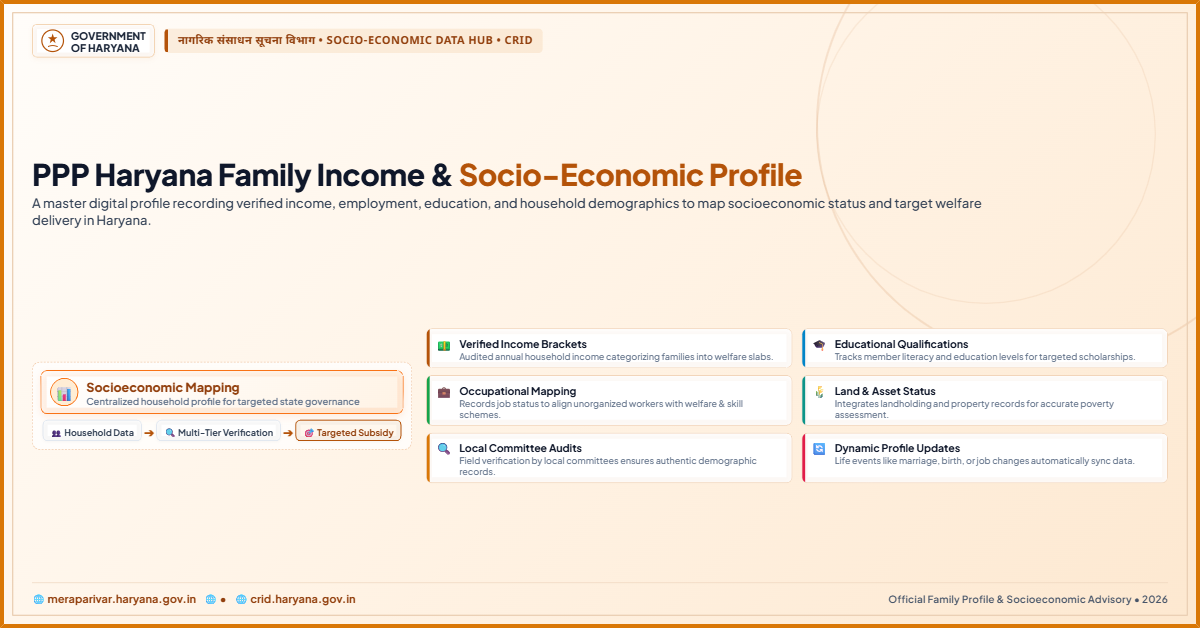
Your verified annual family income places your household in one of four groups. Each group opens a different set of PPP Benefits & Schemes.
| Annual Family Income (Per Annum) | Category | Main Scheme Access |
| Up to ₹1,80,000 | BPL / Antyodaya | Yellow or Pink ration card, free Chirayu cover, pensions |
| ₹1,80,001 – ₹3,00,000 | Lower Middle | Chirayu cover at ₹1,500 per year |
| ₹3,00,001 – ₹6,00,000 | Middle | Chirayu cover at ₹4,000 per year |
| Above ₹6,00,000 | Higher | Chirayu cover at ₹5,000 per year |
The ₹1.80 lakh line is the main threshold. A family verified at or below that figure qualifies for BPL-linked schemes. Above it, families can still buy Chirayu cover at a graded premium.
How Agricultural Income Is Counted
Two rules work together for farm families.
First, the May 2026 direction says no family should lose schemes meant for the ₹1.80 lakh group merely because it also has agricultural income up to ₹5 lakh.
Second, from July 2026, crop sales below ₹5 lakh through e-procurement are not counted in PPP income. Only e-procurement data above ₹5 lakh is used to set income. Meri Fasal–Mera Byora crop-sale entries are no longer the basis for income assessment.
In plain terms: small and tenant farmers selling under ₹5 lakh of crops no longer see that revenue push them above the BPL line.
PPP Benefits & Schemes Linked to Your Family Profile
An updated PPP profile triggers benefits without separate applications for most programmes.
Food Security and Ration Cards
Yellow ration cards go to families verified at ₹1.80 lakh or below. Pink (Antyodaya) cards go to the poorest households. The card is generated from PPP data without a manual office visit.
Chirayu Haryana and Ayushman Bharat
The Chirayu–Ayushman Bharat scheme gives up to ₹5 lakh per family per year of cashless hospital treatment. Eligibility is set by verified annual income in PPP.
- ₹1.80 lakh to ₹3 lakh: ₹1,500 per year
- ₹3 lakh to ₹6 lakh: ₹4,000 per year
- Above ₹6 lakh: ₹5,000 per year
Social Security Pensions
The Social Justice Department uses PPP data to auto-sanction the Old Age Samman Allowance when a resident turns 60. Widow and disability pensions follow the same route. Payment starts after age and income are verified in the family profile.
Other Linked Programmes
Other schemes tied to PPP income include the Mukhyamantri Parivar Samridhi Yojana and marriage assistance programmes.
Steps to File an Income Correction Request
Step 1: Open the portal
Go to meraparivar.haryana.gov.in on any browser and click the grievance or Citizen Corner option on the homepage. Keep your Family ID and Aadhaar number ready before you begin.
Step 2: Log in
Type your 8-digit Family ID or the mobile number registered with the family head. Wait for the OTP, enter it, and the dashboard will open with your household details on screen.
Step 3: Pick the grievance type
Choose “Income” from the grievance list, then select the name of the family member whose figure is wrong. Corrections apply member by member, not to the whole family at once.
Step 4: Enter the correct income
Type the actual annual family income for the entire household. Do not enter monthly earnings, because every slab in the table above compares yearly figures only.
Step 5: Upload proof
Attach a salary slip, employer certificate or bank statement showing salary credits. The portal cross-checks it against CBDT, EPFO and e-procurement data, so a self-declaration alone won’t change your slab.
Step 6: Submit
Click submit and download the acknowledgment slip. Note the reference number carefully, because you’ll need it every time you follow up online or at an office.
Step 7: Track it
Enter the reference number on the portal to see where your case stands. Gram Sabha or committee verification usually moves the file forward within a few weeks of submission.
Step 8: Confirm the update
Recheck the portal after 15 to 30 working days. Your revised slab and linked scheme eligibility will show the verified figure once the file closes.
What Happens If You Do Not Declare Income
The Haryana Parivar Pehchan Authority has said that if a family does not declare income, the PPP record may show an annual income of ₹1.80 lakh to ₹3 lakh.
Mobile messages go to registered numbers, and families get about one week to declare the correct figure before that range is entered. The range sits above the BPL line, so ignoring the message can affect scheme access.
Socio-Economic Impact of PPP on Haryana Households
The single family identifier has changed how welfare reaches people.
Duplicate benefits have fallen. Cross-linking Aadhaar and family data removed repeated ration cards across districts. In December 2022, yellow ration cards were discontinued for 9,60,235 families after verification found ineligible income declarations.
Manual visits matter less. When a member turns 60 or a widow’s status is verified, the system flags the benefit without a fresh application. Gram Sabha verification now settles disputed income figures at the village level.
Accuracy is enforced. In April 2025, 6.84 lakh families faced scrutiny over allegedly false income details used for BPL and AAY benefits. They were given time to correct their PPP records.
Conclusion
The PPP Haryana Family profile is the economic mirror of your household in the state’s welfare system. The verified annual income figure decides whether you receive a yellow ration card, free Chirayu cover or a monthly pension.
The system rewards accuracy. Families that declare income on time and respond to verification messages keep their benefits.Those who ignore notices risk being placed in the ₹1.80 lakh–₹3 lakh range or losing access altogether.
Check your Family ID, confirm your annual slab and use the grievance module if something looks wrong. A corrected profile protects the support your household depends on.
Frequently Asked Questions
Q. What is the PPP Haryana Family ID?
It is an 8-digit household number issued to a family in Haryana. It maps the family’s verified income and socio-economic details to state welfare schemes.
Q. What annual income qualifies a family as BPL?
A verified annual family income up to ₹1,80,000 qualifies a household for BPL-linked benefits. This figure is checked against tax, electricity and e-procurement records before approval.
Q. How is income verified under PPP?
The portal checks CBDT tax records, electricity usage, property data and EPFO entries. Income Verification Committees and Gram Sabhas also confirm the reported figure through field checks.
Q. Does agricultural income affect BPL eligibility?
No family should lose ₹1.80 lakh-group schemes merely because it has agricultural income up to ₹5 lakh. Crop sales below ₹5 lakh through e-procurement are not counted in PPP income.
Q. Can I correct my income online?
Yes. Open the grievance module on meraparivar.haryana.gov.in and submit an income correction request. Attach formal proof such as a salary slip or employer certificate.
Q. How long does re-verification take?
Gram Sabha or committee verification usually takes 15 to 30 working days after you submit the grievance. You can track the status using your reference number.
Q. What if I do not declare income?
The PPP record may show an annual income of ₹1.80 lakh to ₹3 lakh. The authority sends a mobile message first and gives about one week to respond.
Q. Is PPP mandatory for Chirayu cover?
Yes. Eligibility and premium are set by the verified income in the PPP Family ID. Without a valid PPP record, Chirayu enrollment cannot be processed.
Q. How much does Chirayu cost above the BPL line?
Families earning ₹1.80 lakh to ₹3 lakh pay ₹1,500 per year. Families earning ₹3 lakh to ₹6 lakh pay ₹4,000 per year, and those above ₹6 lakh pay ₹5,000 per year.
Q. Does each member need a separate PPP ID?
No. One 8-digit Family ID covers the whole household, and every member is listed under it. Separate IDs are not issued to individual members.
Q. How many districts does PPP cover?
PPP covers all 23 districts of Haryana, including Hansi, which became the 23rd district on 22 December 2025.
Q. What is the PPP helpline?
The official toll-free helpline is 1800-2000-023. You can also raise queries through the grievance module on the official PPP portal.