How Does Household Size Relate to PPP Family Income?
A new baby joins your Family ID, but your total income stays the same. Does that change your Chirayu tier or BPL status? No. Yet many PPP Haryana Family records carry this false assumption, leading to incorrect expectations about welfare eligibility.
Quick Answer : Family Income & Profile: PPP Haryana slabs use total verified annual family income, not per capita. Adding a dependent changes the per-person math on paper but does not move the family into a lower benefit bracket, because total household earnings stay unchanged.
Why the Per-Person Math Does Not Change Your Welfare Slab
Many people assume that a bigger household automatically means a lower income category. That assumption feels logical, but it is wrong under Haryana’s current rules.
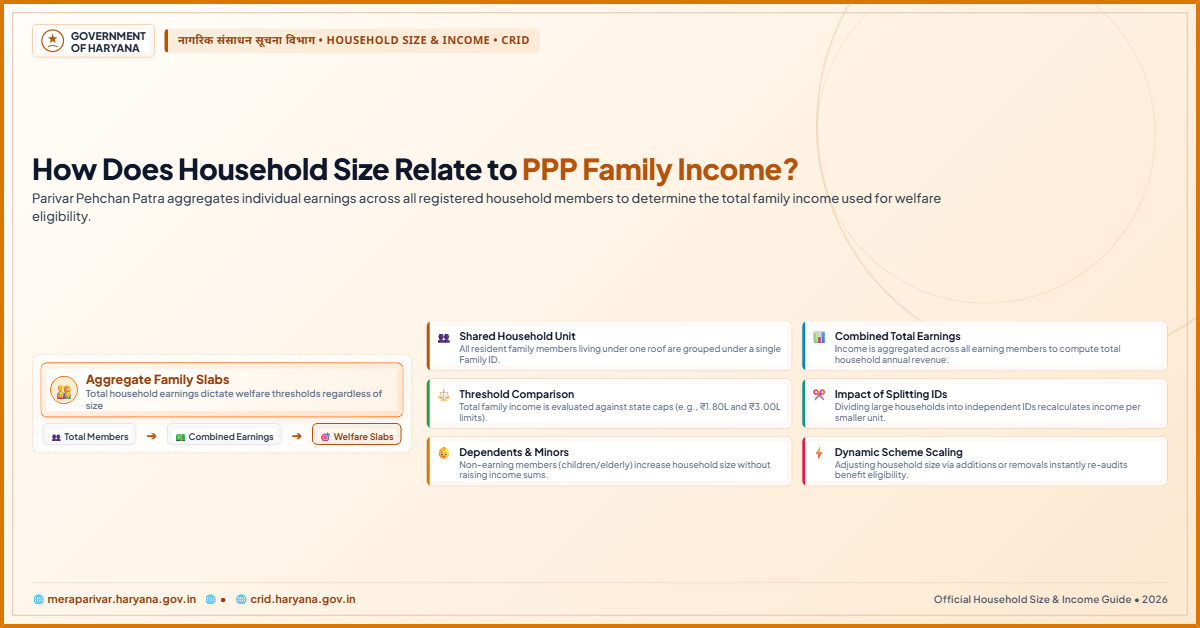
The Citizen Resources Information Department (CRID) records one verified annual income figure for the whole family. Welfare schemes then check that total against fixed rupee thresholds.
If a family earns ₹2 lakh a year and a baby is added, the family still earns ₹2 lakh. The BPL line stays at ₹1.80 lakh, and the family does not cross it just because the household now has one more member.
This is the single most important correction to understand. Household size does not reset your official income tier.What it changes is the per capita calculation — total income divided by member count.
That number is useful for research and for understanding living standards, but it is not the number that decides your ration card type or your Chirayu premium.
What Household Size Actually Affects
If size does not change the slab, why does it matter at all? Because household size controls who sits inside the income pool and whether the declared total survives verification.
A family of six with one earner will declare that earner’s income as the family total. A family of three with the same earner declares the same total.
The slab outcome can be identical. But the larger family may have more dependents whose Aadhaar details, residency records, and employment status must line up inside the Family Information Data Repository (FIDR).
Household size also matters when members move, marry, or pass away. These events change the member list, and an outdated list can freeze scheme benefits even when the income figure is correct.
Haryana’s PPP now handles these updates across all 23 administrative districts, including Hansi, which was designated the state’s 23rd district on 22 December 2025. Families in the Hansi district use the same PPP correction channels as every other district.
The Real Numbers Behind the Confusion
Haryana’s PPP data carries a well-known gap between macro state averages and family-level reality.The state Economic Survey for 2025-26 projected a per capita income of ₹3,95,618, which implies an average family income near ₹16 lakh.
Yet the PPP database, as of March 2025, showed 51.83 lakh families earning below ₹1.80 lakh — about 70% of roughly 73 lakh families in the state.
That gap is not caused by household size. It reflects deep income inequality between high-earning urban pockets and the rest of the state. Household size simply does not move a family across the ₹1.80 lakh line unless the family’s total earnings themselves cross it.
The 2021 PPP figures of ₹61,558 per capita income and ₹2,47,962 per family income are also widely quoted. Treat them as historical benchmark numbers from the August 2021 rollout, not as a current picture of the database.
Income Thresholds That Decide Your Benefits
| Total Verified Annual Family Income | Main Benefit Impact |
|---|---|
| Below ₹1.80 lakh | BPL ration card, free Chirayu cover up to ₹5 lakh, social security pensions |
| ₹1.80 lakh to ₹3 lakh | Chirayu cover with ₹1,500 annual contribution per family |
| ₹3 lakh to ₹6 lakh | Chirayu cover with ₹4,000 annual contribution |
| Below ₹6 lakh | Backward Class certificate eligibility |
| Above ₹6 lakh | Higher-tier certificates and several scholarships unavailable |
Every row in this table uses total family income, not income per person. A household of eight earning ₹1.5 lakh total still qualifies for the BPL line. A household of two earning ₹4 lakh does not, no matter how small the family is.
Steps to Check and Correct Your Family Income Record
If your member list is wrong or your income figure looks outdated, fix it through the official portal. Each step below covers one action, so you can pause and check your work before moving ahead.
Step 1: Open the Mera Parivar Portal
Use a secure browser and go to the official Mera Parivar portal. Avoid lookalike sites that ask for payment before showing your Family ID details. Bookmark the correct page so future visits land in the right place.
Step 2: Log In With Your Family ID or Aadhaar
Enter your Family ID in the login field. If you do not have the Family ID handy, use your registered Aadhaar number instead. Both routes lead to the same household profile.
Step 3: Complete OTP Verification
The portal sends a one-time password to the mobile number linked to your Family ID. Enter it within the time limit to confirm your identity. If the OTP does not arrive, check that your mobile number is still current in the system before retrying.
Step 4: Review the Member List
Open your dashboard and read through every name listed under your household. Confirm that each person shown actually lives with you, and that no one is missing. Newborns, newly married spouses, and elderly parents are the most common omissions. The official self-updation procedure explains the rules for adding or removing members.
Step 5: Check the Verified Annual Income
Look at the income figure attached to your family profile. This is the number that scheme portals read when they test your eligibility. Compare it with your actual salary slips, pension records, or IT returns. A mismatch here is the most common cause of frozen benefits.
Step 6: Submit a Correction Request
If the member count or income is wrong, file a correction request through the grievance or update module.
Attach proof such as salary slips, IT returns, or pension records when asked.
Save your request number and follow up if the status does not change.
For families in Hansi district, the same portal and the same correction module apply. The district’s creation did not change the PPP income rules; it only changed the administrative map that PPP updates must match.
Conclusion
Household size and PPP family income connect through a simple but often misunderstood rule. The family is the unit. Total verified income decides your slab. Per capita income is a derived number, not a welfare key.
Adding a dependent does not lower your bracket, but leaving a wrong member count on your Family ID can delay benefits and create verification problems. Keep the member list accurate, check the income figure, and use the official correction channel when something changes.
Frequently Asked Questions
1. Does adding a baby to my PPP Family ID lower my income slab?
No. The slab depends on total verified family income. A new dependent does not change the family’s total earnings, so the slab stays the same.
2. Does Haryana use per capita income for BPL or Chirayu?
No. BPL, Chirayu, and Backward Class certificate limits are based on total verified annual family income, recorded against the Family ID.
3. My family earns ₹2 lakh with six members. Do we qualify for BPL?
No. The BPL threshold is ₹1.80 lakh per family per year. Your total income is above that line, regardless of how many people share it.
4. How do I correct a wrong member count if I live in Hansi district?
Use the Mera Parivar portal’s grievance or correction module. Hansi families follow the same PPP correction process as the other 22 districts.
5. Are the 2021 PPP income figures still current?
No. The ₹61,558 per capita and ₹2,47,962 per family figures come from August 2021 data. Use them as historical benchmarks, not as today’s state averages.
6. What happens if my Family ID shows the wrong income?
Your scheme eligibility can be frozen or misclassified. Submit proof through the correction module so CRID can re-verify the total family income against tax and salary records.