How Does PPP Haryana Connect Family Information Across Government Services?
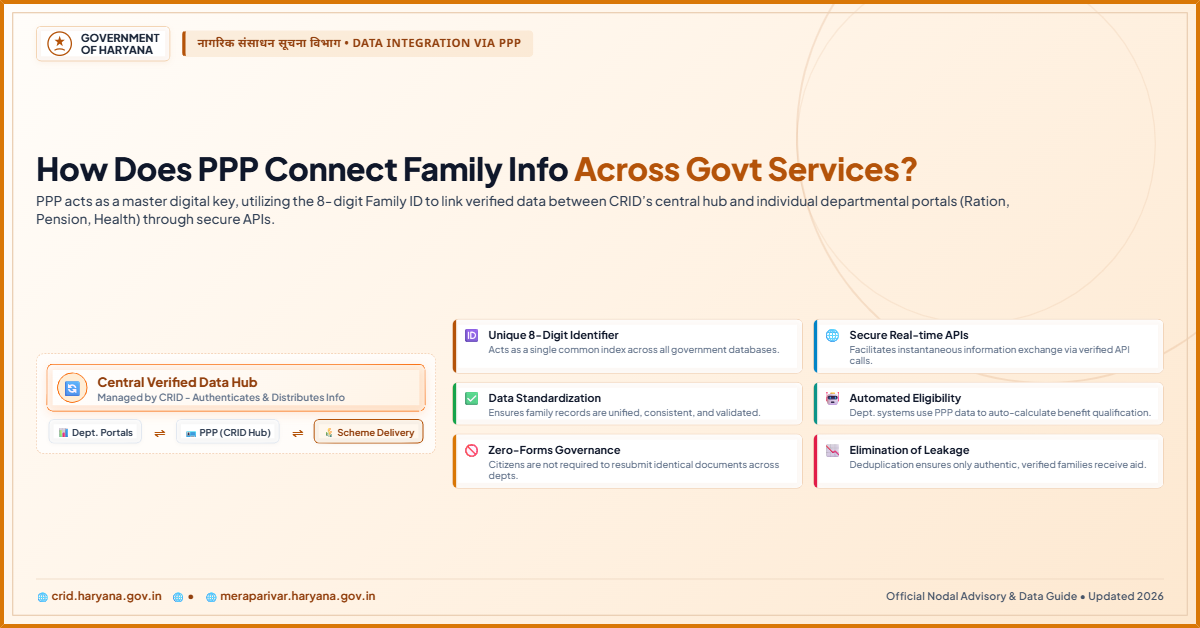
Struggling with endless paperwork for government schemes? The PPP Haryana Family system fixes that. This 8-digit Family ID links your household data across all state departments, so benefits reach you automatically — no repeated applications, no queues.
Quick Answer : The PPP Haryana Family ID connects family information across government services through the Family Information Data Repository (FIDR), a centralized database managed by the Citizen Resource Information Department that automatically shares verified income, age, and demographic data with portals like SARAL to trigger welfare benefits without paper applications.
How Secure Is the PPP Data and What Protects Citizens?
A central database holding income, caste, and family details for crores of citizens raises a fair question: is this data safe? Haryana has built multiple layers of protection around the Family Information Data Repository (FIDR) to address this concern.
Technical Security Infrastructure
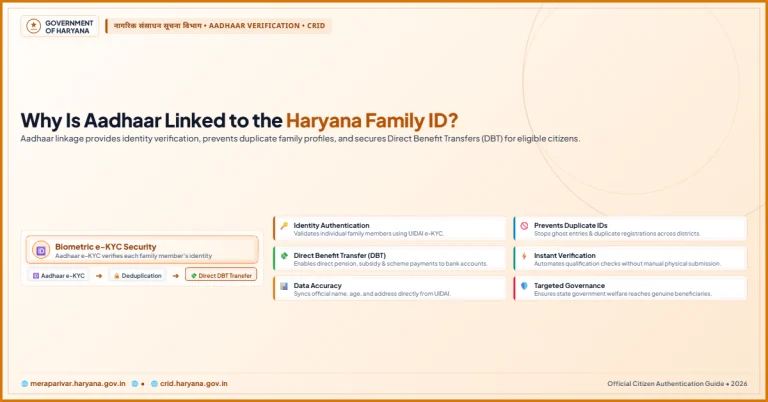
The PPP platform is hosted on the NIC State Mini Cloud and uses the NIC Aadhaar Data Vault for safeguarding Aadhaar and related data . Data is stored securely on Government Cloud, and the portal works on an authorized user access basis only — it does not provide open access to data .
Sensitive identifiers like Aadhaar and PPP numbers are encrypted both during transmission and at rest. Servers are located in India with firewalls and intrusion prevention systems. Only authorized personnel can access data, following a strict need-to-know principle .
Legal Protections and Penalties
The Haryana Parivar Pehchan Act, 2021 includes strong deterrents against data misuse. Tampering with information stored in the FIDR carries a penalty of 10-year imprisonment or a ₹50 lakh fine . This provision was enforced in April 2023 when an FIR was lodged against two Common Services Centre operators in Hisar district for illegally altering family IDs .
Controlled Data Sharing Rules
In February 2025, the Haryana Parivar Pehchan Authority issued strict regulations governing data sharing.
Family information can only be shared with an “Eligible State Instrumentality” — which includes the Central government, Haryana state government, statutory authorities, universities, boards, and corporations. The shared data can only be used for government programs, recruitment verification, and public service benefits .
Citizens also retain rights over their data, including the right to access, correct, update, or delete personal information, and to withdraw consent for processing .
Centralized Architecture: The Family Information Data Repository
The FIDR functions as the single source of truth for every household in Haryana. Instead of treating citizens as isolated applicants, the platform structures data around the entire family unit. It captures each member’s name, date of birth, caste, disability status, address, annual income, and land holdings .
This centralized structure eliminates duplicate records that once plagued state administration. Before PPP, each department maintained separate databases, leading to verification delays and fraudulent claims. The FIDR now serves as a unified repository that all government verticals query for verified household data.
How Departments Share Data Through PPP
When a citizen applies for a service through the SARAL portal or seeks a welfare grant, the target department queries the central repository. Since identity, residence, and income are already authenticated, individual departments skip separate field verification.
| Department / Portal | Integration Type | Operational Benefit |
| SARAL Portal | Application auto-fill | Eliminates duplicate identity proofs |
| Food & Supplies | Automated eligibility mapping | Issues BPL ration cards based on verified income |
| Social Justice & Empowerment | Age and life-event tracking | Generates old-age pensions automatically at age 60 |
| Civil Registration System | Dynamic life-event sync | Updates family structures on birth, death, or marriage |
The Antyodaya SARAL Portal integrates directly with PPP to auto-fill verified details of citizens. Out of 315 services available through SARAL, 286 services have already been integrated with the PPP portal.
Proactive Governance and Automatic Benefit Delivery
The system’s biggest shift is moving from reactive governance to proactive service delivery. Citizens no longer need to complete manual applications or visit government offices to claim eligible benefits.
Automatic Pension Enrollment: When a registered individual turns 60, the system cross-checks age data with verified income. Eligible old-age social security pensions begin without requiring a fresh application.
Dynamic Ration Card Reclassification: Income updates in the repository trigger automatic changes in Public Distribution System eligibility, generating or updating BPL ration cards instantly.
Scholarship and Fee Concessions: Educational institutions fetch real-time family income records to award fee waivers to qualifying students.
The government has already started proactive delivery of SC caste certificates without citizens applying, and auto-grant of Vivah Shagun benefits after marriage registration is in progress.
How Real-Time Life Event Tracking Works
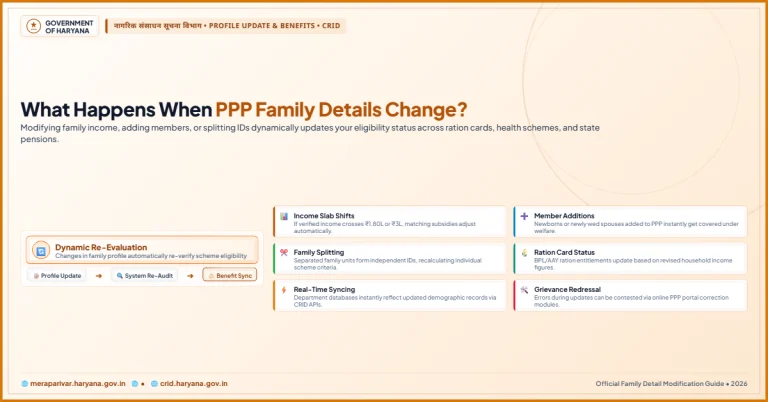
Static databases become outdated quickly. The FIDR addresses this by linking directly with the state’s Civil Registration System (CRS) :
- Births: Registering a birth automatically adds the newborn to the household entry.
- Marriages: A marriage record triggers an option to split or merge existing household units.
- Deaths: A registered death updates the family profile, preventing unauthorized benefit claims.
The Registrar General of India pushes daily birth and death data to the Government of Haryana, ensuring the repository remains current .
Steps to Verify and Link Family Information Across Portals
Residents can update details or link household data to government services using online tools or assisted service centers.
Step 1: Access the Citizen Portal
Visit the official state portal (meraparivar.haryana.gov.in) and select the citizen login option. Enter the 8-digit Family ID or the Aadhaar number of the head of the household.
Step 2: Authenticate via One-Time Password
The portal sends an OTP to the mobile number registered with the Aadhaar record. Enter the code to access the active household dashboard.
Step 3: Review and Modify Profile Attributes
Review member names, relationships, income markers, and employment status. Use the correction module to submit updates alongside supporting documents like birth certificates or income declarations.
Step 4: Submit Signed Verification Document
Download the updated profile draft, print it, and affix the signature of the head of the family. Upload the scanned PDF back to the portal to complete verification.
Step 5: Link Services on the SARAL Platform
When applying for state services on saralharyana.gov.in, enter the validated Family ID. The form automatically populates personal details, income tier, and residency status directly from the central database.
Citizens can also update unverified information at their nearest Atal Seva Kendra, Common Service Centre (CSC) , or SARAL Kendra.
Conclusion
The Parivar Pehchan Patra initiative transforms separate departmental records into an interconnected administrative network.
By maintaining a single verified source of household data, Haryana eliminates paperwork, cuts welfare leakage, and automatically delivers benefits to citizens when they qualify.
With robust encryption, strict legal penalties, and controlled data-sharing rules, the system balances efficiency with citizen privacy protection.
Frequently Asked Questions
What is the main purpose of the Haryana PPP system?
It establishes a single verified household database across Haryana to automate benefit distribution without duplicate physical documents.
How does the system automatically grant benefits?
By linking verified age, income, and family data directly with department portals to trigger schemes automatically upon meeting eligibility criteria.
Can non-residents register on the Haryana PPP portal?
Yes, non-residents applying for state schemes receive a temporary 9-digit identifier prefixed with the letter “T”.
How are changes in family structure tracked over time?
The platform connects with the Civil Registration System to automatically update births, deaths, and marriages in real time.
What authority manages the central family repository?
The Citizen Resource Information Department (CRID) maintains, verifies, and secures the Family Information Data Repository under state law.
Where can citizens edit unverified family information?
Citizens can update unverified information through the official portal or by visiting an authorized Common Service Centre (CSC) or SARAL Kendra.