Can PPP Family Data Be Used for Government Scholarships?
Your PPP Haryana Family record decides whether a scholarship clears verification or fails on a data mismatch. Haryana pulls income, caste, and domicile from Parivar Pehchan Patra into Har-Chhatravratti. For 2026-27, NSP One-Time Registration (OTR) must be generated first—before you touch the state portal.
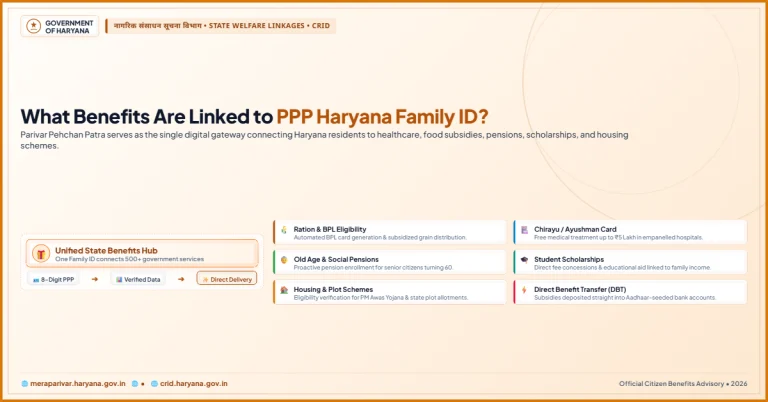
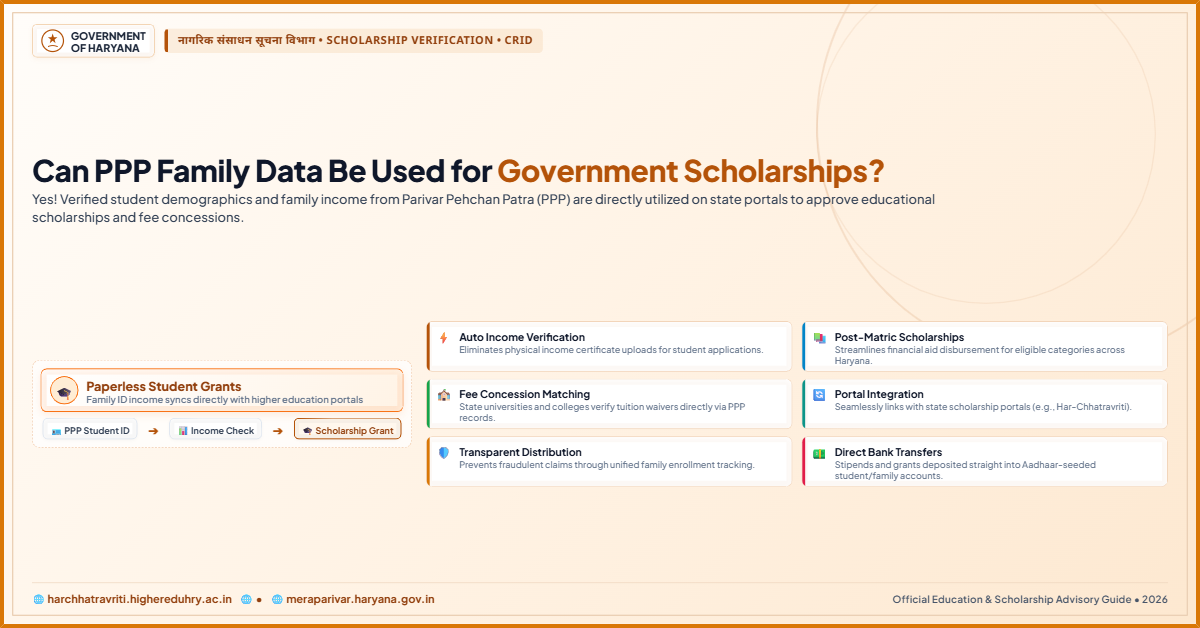
Quick Answer : Yes. Your PPP Haryana Family data is the primary verification source for government scholarships in Haryana. The Har-Chhatravratti portal auto-fetches income, domicile, and category details from your Family ID to approve PPP Benefits & Schemes, but Post Matric applicants must first complete NSP OTR before starting the Har-Chhatravratti registration.
Why the PPP Family ID Controls Scholarship Eligibility
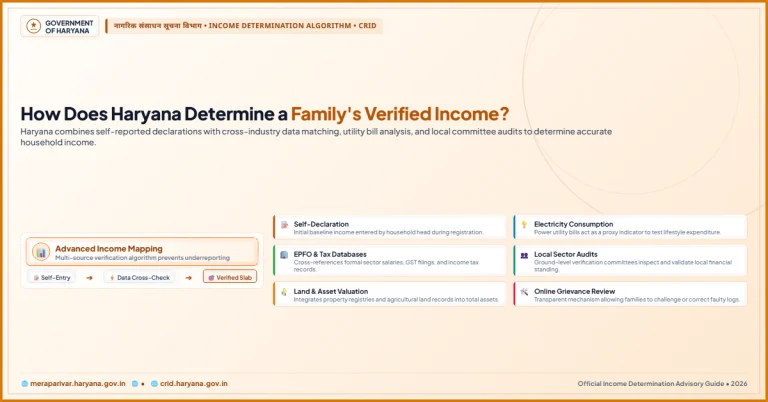
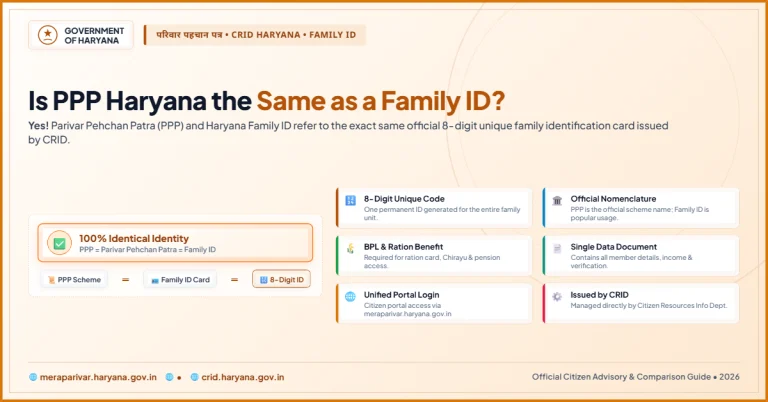
Haryana built the Parivar Pehchan Patra system to create one verified household record for every family in the state. Each household receives an eight-digit Family ID linked to birth, death, marriage, and income data.
When the state launched the Har-Chhatravratti scholarship portal, it wired that same database into the application workflow.
The Har-Chhatravratti Standard Operating Procedure states that domicile, family income, caste category, and Aadhaar details are auto-fetched from the Parivar Pehchan Patra and remain non-editable on the application form.
Students do not upload separate income or caste certificates at a government counter. The portal pulls the verified family record the moment the Family ID is entered.
This matters because a wrong entry on the PPP Haryana Family profile becomes a wrong entry on the scholarship form. The system inherits the error, not the student’s actual circumstances.
The 2026-27 System Change: NSP OTR Comes First—Before Har-Chhatravratti
For the active academic session, the National Scholarship Portal (NSP) One-Time Registration sits outside and before the Har-Chhatravratti workflow.
The NSP portal confirms that OTR is mandatory for applying for various scholarship schemes hosted on NSP or other portals. An active mobile number is mandatory, and no fee is charged for OTR.
The 14-digit OTR number is generated through Aadhaar eKYC and face authentication, and it remains valid for the student’s entire academic career.
Merely generating an OTR does not mean you have applied for a scholarship; you still register on Har-Chhatravratti with your PPP Family ID and submit the application separately.
What PPP Data the Scholarship Portal Actually Checks
The Har-Chhatravratti system does not ask for every field manually. Several attributes arrive pre-filled and locked from the PPP Haryana Family record. The table below shows the exact data fields and what they are used for.
| Data field | Source | Used for |
| Annual family income | Verified PPP database | Matched against scheme-specific income ceilings |
| Domicile status | PPP household record | Confirms Haryana residency for state-level awards |
| Caste or category | PPP family profile | SC, BC, EWS, and other classification checks |
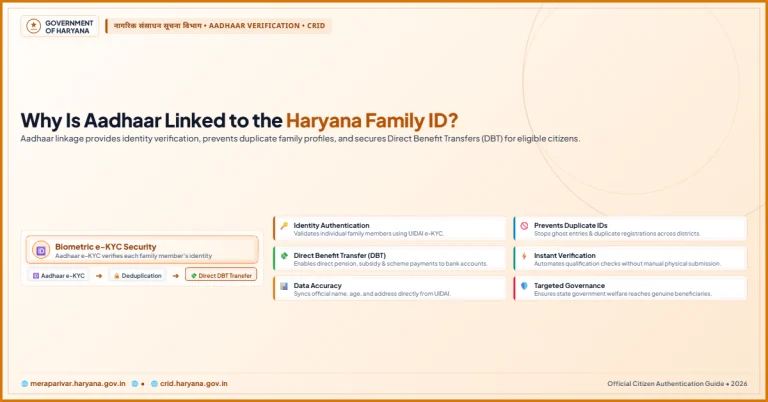
| Aadhaar details | PPP-linked Aadhaar | Identity confirmation and Direct Benefit Transfer (DBT) matching |
If any of these details are wrong in the PPP record, the scholarship application inherits the same error. Students must correct the Family ID data before applying, not after rejection.
Which Scholarships Use PPP Family Data?
Most state-level scholarships routed through Har-Chhatravratti evaluate applicants against the income and category details stored in the PPP Haryana Family profile.
| Scholarship scheme | Who it targets | PPP data used |
| Post Matric Scholarship (SC) | SC students in post-matric programmes | Annual income ceiling of ₹2.50 lakh; caste category; domicile |
| Post Matric Scholarship (BC) | Backward Class students | Annual income ceiling of ₹2.50 lakh; category; domicile |
| Post Matric Scholarship (EWS/DNT) | EWS and DNT students | Annual income ceiling of ₹2.50 lakh; category; domicile |
| Lower Income Group Scheme | Students in recognised post-matric courses | Income up to ₹12,000 per annum under the legacy scheme structure |
| State Merit Scholarship (UG/PG) | High-performing undergraduate and postgraduate students | Academic record plus category and domicile |
| Consolidated Stipend Scheme (SC) | SC students in degree programmes | Caste and income verification through PPP |
The Post Matric Scholarship for SC, BC, EWS, and DNT students enforces the same ₹2.50 lakh annual family income ceiling on the Har-Chhatravratti portal.
Reporting from the portal’s 2025-26 reopening states plainly that “annual family income should be less than ₹2.5 lakh” for SC, BC, EWS, and DNT categories.
The Directorate of Welfare of Scheduled Caste & Backward Classes, Government of Haryana, similarly states that “the limit of annual income of the parents/guardians is Rs. 2.50 lakh” for the SC scheme.
This is where confusion commonly enters. Haryana’s EWS reservation certificate uses a different, much higher income threshold—₹6.00 lakh, since revised to ₹8.00 lakh for the EWS category in state recruitment and admissions.
That is a reservation eligibility figure. It is not the Post Matric Scholarship ceiling. The Har-Chhatravratti financial-aid scheme for EWS students remains tied to ₹2.50 lakh. Conflating the two sends low-income EWS applicants looking for the wrong number.
The Lower Income Group Scheme operates on a much narrower legacy slab. Official scheme listings confirm the income limit at ₹12,000 per annum for this category. Applicants must confirm the exact slab that applies to their course and institution.
Step-by-Step: Using Your PPP Family ID for a Scholarship (2026-27)
The OTR belongs at the absolute beginning of the process. It is not a middle step inside the Har-Chhatravratti form. Skipping it blocks the application before registration even starts.
Step 1: Generate NSP One-Time Registration (OTR)
Go to the National Scholarship Portal and complete OTR through Aadhaar registration. Save the 14-digit OTR number. An active mobile number is mandatory, and OTR is free. This step applies to Post Matric Scholarship applicants for SC, BC, EWS, and DNT categories.
Step 2: Verify the PPP Haryana Family Record
Log in to the PPP portal with the eight-digit Family ID. Check the name, date of birth, father’s name, caste category, and total annual income. A mismatch here becomes a mismatch on the scholarship portal because the data is non-editable after auto-fetch.
Step 3: Open the Har-Chhatravratti Portal
Go to the Har-Chhatravratti centralized scholarship portal run by the Department of Higher Education, Haryana. This is where the state-level application begins, now that OTR is already in hand.
Step 4: Register with the Family ID
Select student registration and enter the PPP Haryana Family ID. Choose the correct family member from the dropdown and generate an OTP sent to the mobile number registered on the PPP profile.
Step 5: Confirm the Auto-Filled Data
After OTP verification, the portal fills domicile, family income, caste category, and Aadhaar details from the PPP database. These fields are non-editable. Review them carefully against the scheme’s income ceiling. For the Post Matric schemes on this portal, that ceiling is ₹2.50 lakh across SC, BC, EWS, and DNT.
Step 6: Upload Academic and Banking Documents
Attach the previous marksheet, fee receipt, and bank account details linked to Aadhaar. Scholarship money moves through DBT, so the bank account must be Aadhaar-seeded.
Step 7: Submit and Track Three-Level Verification
The application passes through institute, university or nodal body, and head office verification. Students can log in to check real-time status.
What Happens When the Income Data Does Not Match
An incorrect income entry on the PPP Haryana Family profile is the most common blocker. If the recorded income exceeds the scheme ceiling, the portal rejects the application even when the family’s actual income is lower.
The fix is a PPP correction request, not a scholarship portal complaint. The family must raise a grievance on the PPP system and get the income record updated through the designated verification process. Once the corrected data reflects in the database, the scholarship application can be submitted again.
The risk is sharpest for EWS applicants who mistake the reservation threshold for the scholarship ceiling. A family earning ₹4 lakh may hold a valid EWS certificate under the higher reservation limit but still fail the ₹2.50 lakh Post Matric Scholarship cap on Har-Chhatravratti.
The portal checks the financial-aid rule, not the reservation rule. A student must match the scheme to the correct ceiling before submitting, or the application will be blocked on a number that belongs to a different policy entirely.
Conclusion
The PPP Haryana Family ID is not optional for government scholarships in Haryana. For 2026-27, the sequence is fixed: generate NSP OTR first, then register on Har-Chhatravratti with the Family ID, and let the Parivar Pehchan Patra database supply the income, caste, and domicile verification.
The ₹2.50 lakh ceiling applies to Post Matric Scholarships across SC, BC, EWS, and DNT on this portal. The ₹6.00 lakh to ₹8.00 lakh figure that students encounter elsewhere is the EWS reservation income limit, not the scholarship limit.
The Lower Income Group Scheme sits separately at ₹12,000 per annum. These are hard thresholds, and they do not travel together. Review the Family ID profile, confirm the correct scholarship-specific ceiling, and complete OTR before every application cycle. A clean PPP record turns a complicated process into a mostly auto-filled form.
Frequently Asked Questions
Is a PPP Family ID mandatory for Haryana government scholarships?
Yes. The Har-Chhatravratti portal requires a valid Parivar Pehchan Patra Family ID for every applicant seeking state scholarship benefits.
Do I need NSP OTR before applying on Har-Chhatravratti for 2026-27?
Yes. OTR is mandatory for applying for scholarship schemes hosted on NSP or other portals. Generate the 14-digit OTR on NSP before beginning registration on Har-Chhatravratti.
What is the income limit for the Post Matric Scholarship on Har-Chhatravratti?
The annual family income ceiling is ₹2.50 lakh for the Post Matric Scholarship categories routed through the portal, including SC, BC, EWS, and DNT.
Is the EWS Post Matric Scholarship income limit the same as the EWS reservation limit?
No. The Post Matric Scholarship for EWS students on Har-Chhatravratti uses ₹2.50 lakh. The separate EWS reservation income limit in Haryana is ₹8.00 lakh after the recent revision. The two figures serve different purposes and must not be mixed.
What is the income limit for the Lower Income Group Scheme?
The scheme’s official eligibility places income at up to ₹12,000 per annum for the Lower Income Group category on Har-Chhatravratti. This is a legacy ceiling, not a general ₹2.5 lakh threshold.
What if my family income is wrong on the PPP record?
Raise a correction grievance on the PPP system. The scholarship portal cannot override the PPP data until the family record is updated through the designated verification process.