How Does Haryana Determine a Family’s Verified Income?
Your pension form returns an “income mismatch” flag. That flag comes from your PPP Haryana Family record, not from the papers in your hand. The state checks ITR, payroll, land, and power data, then sends rural cases under ₹1.80 lakh to the Gram Sabha. Here is the full chain.
Quick Answer : Haryana locks a household’s verified annual earnings by matching the Family Income & Profile declared in the PPP Haryana Family system against tax, payroll, and land records. Rural families reporting income below ₹1.80 lakh face Gram Sabha review. Once verified, the income certificate is issued through SARAL with the ADC-cum-DCRIO’s facsimile signature.
Where Does Haryana Pull Income Data From?
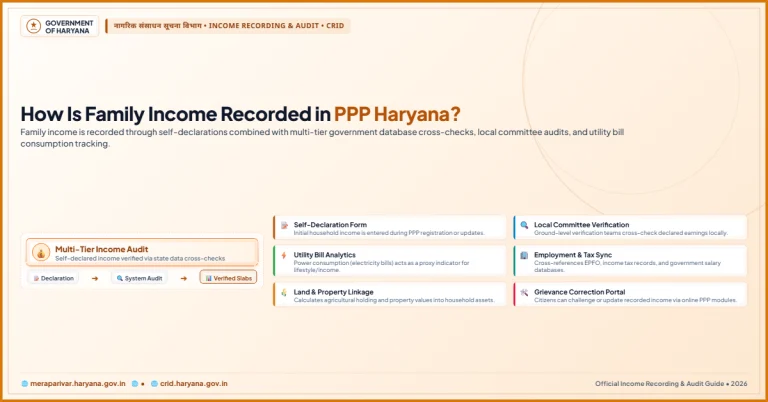
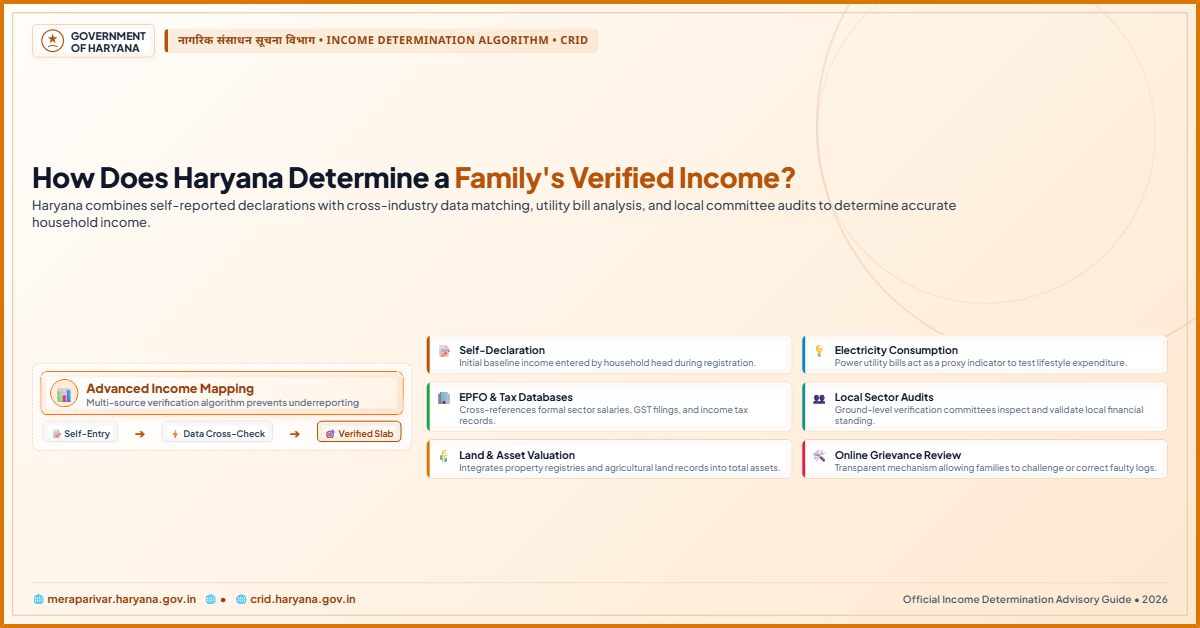
The state runs self-declared income through several electronic checks before treating it as verified.
The main digital sources are:
- Income Tax Returns (ITR): PAN-linked returns are checked for the last three years.
- Government payroll (HRMS): Salaries of Haryana government employees, board staff, and contractual workers are pulled automatically.
- Pension and labour databases: Records of retired pensioners and private-sector workers covered by the Haryana Labour Welfare Board are cross-matched.
- Electricity consumption: Annual power usage from state utilities serves as a proxy for household spending.
- Land and crop procurement records: Agricultural holdings and e-Kharid procurement payments help flag undeclared earnings.
If digital records cannot settle the figure, the case moves to physical verification.
Why Haryana Introduced the Gram Sabha Module
The original Local Committee model produced persistent calculation discrepancies. Different reports from the team leader, local operator, and volunteer often carried conflicting income figures, making the actual income difficult to determine.
To resolve this, the state introduced the Gram Sabha Module. Income figures submitted by the team leader and local operator are presented before the Gram Sabha of the concerned village. The village assembly verifies the household’s actual income, and its decision is treated as final.
The exercise now covers rural families reporting income below ₹1.80 lakh, along with AAY beneficiaries. The Gram Sabha also assesses family structure, the occupation of earning members, and housing condition. Houses with a kachhi chhat are physically inspected and photographed with a family member present.
Steps to Determine and Verify Family Income in Haryana
Verification follows a fixed sequence. Each stage feeds the next, and the endpoint is a certificate the resident can download from SARAL Haryana.
Step 1: Self-Declaration on the PPP Portal
The household head registers the family on Mera Parivar Haryana and enters each member’s occupation, employment type, and estimated annual earnings. This is the starting claim, not the final figure.
Step 2: Automated Digital Cross-Matching
The declared amount is checked against ITR, HRMS, pension, labour, electricity, and land databases. Where digital records produce a clear match, income can be verified without a field visit.
Step 3: Local Committee Assessment
Where digital records are missing, a Local Committee assesses the household through visits or neighbourhood inquiries. The committee records living standards, visible assets, and occupation.
Step 4: Gram Sabha Public Verification
For rural households reporting income below ₹1.80 lakh, the committee’s figures are presented before the Gram Sabha. The village assembly reviews the case and approves the income category. This step replaced the earlier practice of allowing committee estimates to lock automatically.
Step 5: Final Locking and Digital Certificate Issuance
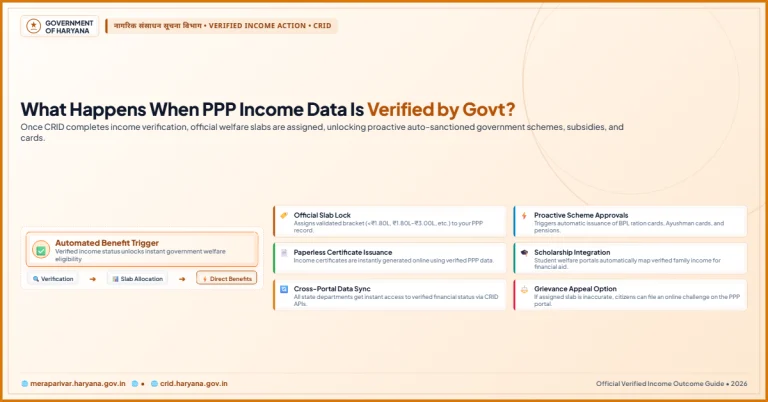
Once approved, the verified income is updated and marked verified. The family ID status changes, and the figure becomes available to scheme portals.
This is also where the resident receives the official document. Haryana does not route the income certificate through a Tehsildar’s manual signature.
The certificate is issued across the counter through the SARAL portal, facsimile signed by the ADC-cum-DCRIO (Additional Deputy Commissioner-cum-District Citizen Resources Information Officer) under whose jurisdiction the family falls.The digital signature makes the certificate valid without a Tehsildar office visit.
How Verified Income Slabs Decide Benefits
Haryana sorts families into income slabs rather than storing one exact rupee figure for every scheme. The Chirayu Ayushman Bharat scheme uses the verified income recorded in the Parivar Pehchan Patra for eligibility.
| Verified Annual Income Slab | Main Welfare Impact |
|---|---|
| Up to ₹1,80,000 | Eligible for BPL (Priority Household) ration card; free Chirayu cover up to ₹5 lakh per year |
| ₹1,80,001 – ₹3,00,000 | Chirayu cover at ₹1,500 per year; BPL ration card not applicable |
| ₹3,00,001 – ₹6,00,000 | Chirayu premium ₹4,000 per year |
| Above ₹6,00,000 | Chirayu premium ₹5,000 per year |
Certificate ceilings work separately from these health slabs. The EWS annual family income limit and the BC creamy layer ceiling both stand at ₹8,00,000, revised from ₹6 lakh to align with central guidelines. The Chirayu premium slabs remain separate from these certificate limits.
How to Correct a Wrong Income Entry
If your family ID shows an inflated or outdated income, the Mera Parivar Haryana portal is the starting point. Haryana uses two correction modes.
Self-Update Mode works through an OTP sent to the head-of-family’s registered mobile number. Once authenticated, basic edits can be made.
Assisted Mode is for cases where the OTP cannot be completed at home, or where the correction needs document validation. A CSC, SARAL Kendra, PPP Operator, or Atal Seva Kendra can open and update the record on the citizen’s behalf.
Complex historical corrections—conflicting old records, ambiguous documents, or cases needing synchronisation with departmental databases—route through Assisted Mode. Carry salary slips, bank statements, or an ITR copy for validation.
If a dispute over a reassessed income flag cannot be settled at the committee stage, the Tehsildar acts as the final reviewing officer.
The Tehsildar is required to upload a “Speaking Order” to the portal—a written, reasoned decision that records the exact documentary evidence used to settle the discrepancy. A speaking order gives the family a traceable legal record of how the dispute was resolved, rather than a verbal outcome.
The request then returns to the Local Committee or Gram Sabha, as applicable. Most corrections complete within 15 to 30 days.
Conclusion
Haryana’s verification model stacks evidence. Digital records catch formal earnings, Local Committees assess informal livelihoods, and Gram Sabhas give the final word on rural cases below ₹1.80 lakh.
The endpoint is not a paper file in a Tehsildar’s office: it is a SARAL-issued certificate facsimile signed by the ADC-cum-DCRIO.
For families applying for welfare, the practical step is straightforward. Check your income slab before applying.
If you are rural and below ₹1.80 lakh, expect Gram Sabha verification. If the entry is wrong, simple fixes can go through OTP self-update, but complex disputes can end with a Speaking Order uploaded by the Tehsildar, giving the correction a formal legal trail.
Frequently Asked Questions
1. What is the BPL income limit in Haryana?
A verified annual family income of up to ₹1,80,000 is the criterion for a BPL (Priority Household) ration card.
2. Who gives the final approval for rural income below ₹1.80 lakh?
The Gram Sabha. For rural households in this bracket, the village assembly reviews the committee’s figures and its decision is treated as final.
3. Who signs the final income certificate in Haryana?
The certificate is facsimile signed by the ADC-cum-DCRIO and issued through the SARAL portal. No Tehsildar signature is required for the standard certificate.
4. Can I correct income entirely through the portal without visiting a CSC?
Basic edits can go through Self-Update Mode with an OTP. If you cannot complete the OTP or the case needs document validation, use Assisted Mode at a CSC, SARAL Kendra, or PPP Operator.
5. What is the income limit for EWS and BC certificates in Haryana?
Both the EWS and BC creamy layer annual income ceilings now stand at ₹8,00,000, revised from ₹6 lakh to match central norms.
6. What happens if I dispute a reassessed income flag?
Complex disputes can be reviewed by the Tehsildar, who uploads a Speaking Order to the portal. This is a written, reasoned decision that records the evidence used to settle the discrepancy, giving the family a formal legal record of the outcome.