What Happens When PPP Income Data Is Verified by the Government?
Your PPP Haryana Family record decides whether your household gets a ration card, pension, or free hospital treatment. Government verification replaces what you declared with figures checked against tax records, land registries, and village-level reviews. In 2026, that check became stricter—and more local.
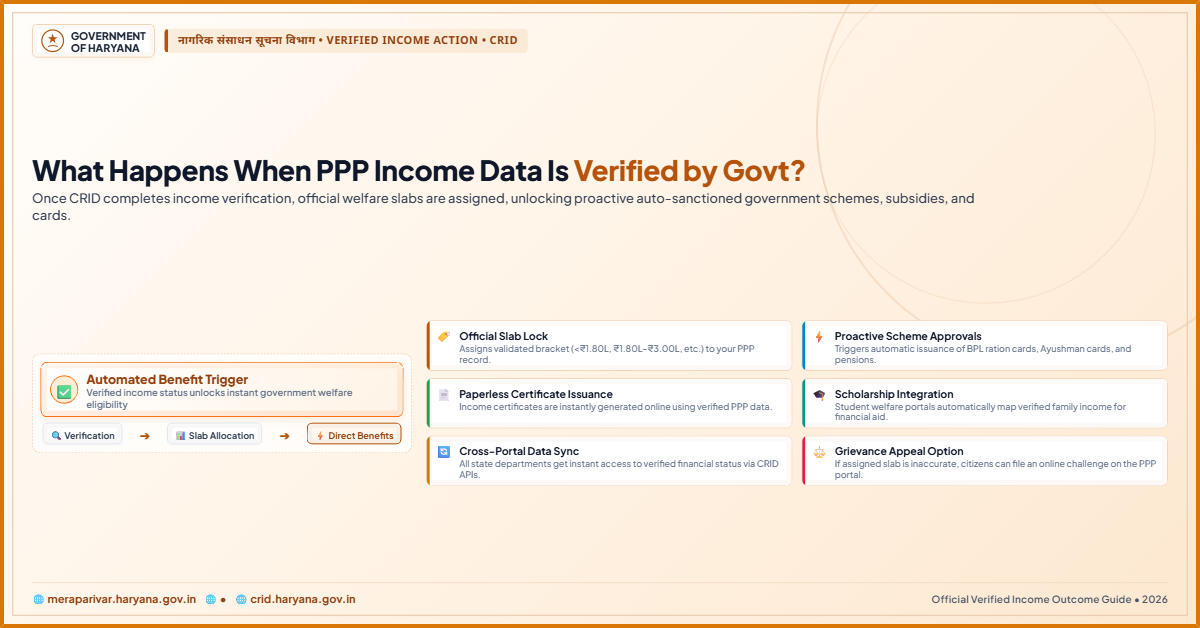
Quick Answer : When the government verifies your PPP income, it updates your Family Income & Profile using tax filings, salary records, land and vehicle data, and Gram Sabha confirmation. Verified income below ₹1.80 lakh unlocks BPL benefits; mismatches or hidden assets can pause or cancel them.
Why Does Verification Matter More in 2026?
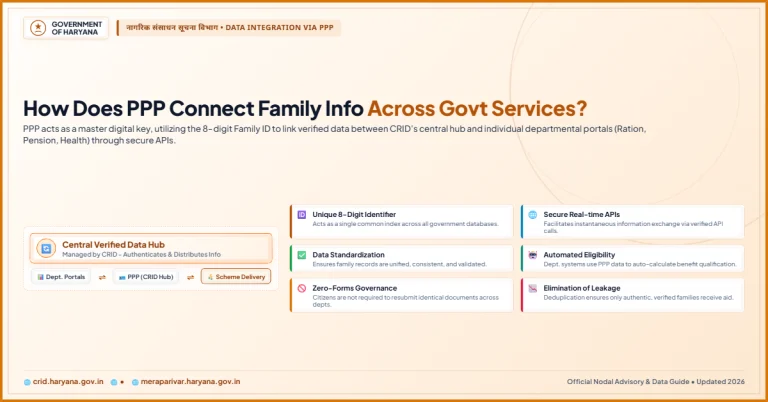
Haryana’s Parivar Pehchan Patra covers over 77 lakh families and nearly 3 crore members across all 23 districts. More than 50 departments use it to deliver over 400 schemes.
The system starts with self-declared income. Without verification, families could underreport earnings and claim benefits meant for poorer households.
The state has closed that gap in two ways: by pushing physical verification into Gram Sabhas, and by linking PPP to asset records that reveal hidden wealth.
What Happens During Verification Now?
Verification runs on three tracks that did not all exist together before 2025–26.
Track 1: Electronic Database Matching
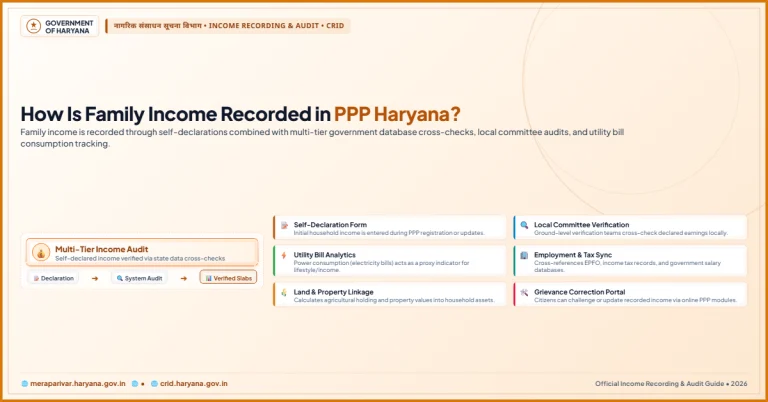
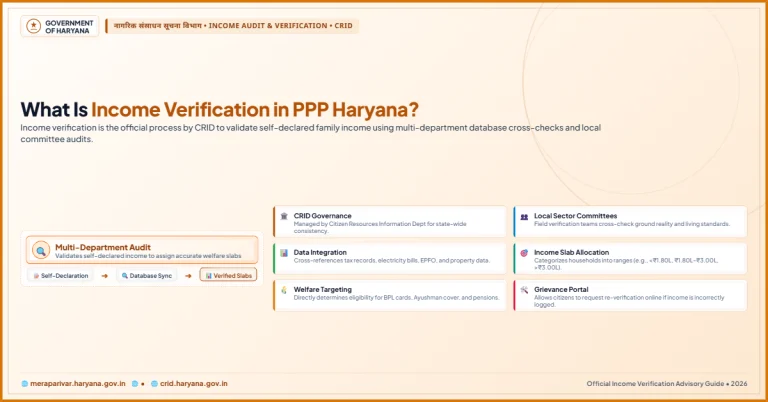
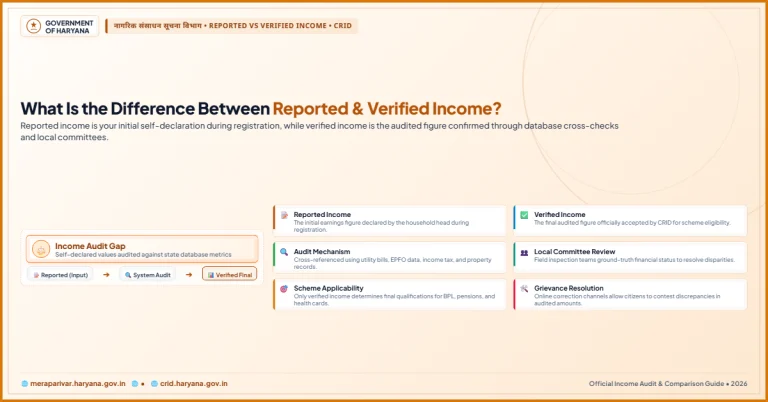
CRID cross-checks declared income against Income Tax Returns through CBDT, HRMS records for state employees, pensioner data, labour welfare records, and electricity consumption data. This remains the first filter.
Track 2: Gram Sabha Verification (Primary Physical Mechanism)
In May 2026, Chief Minister Nayab Singh Saini directed CRID to complete PPP income verification through Gram Sabhas on a priority basis. The reason was practical: Local Committee reports often conflicted, making actual income hard to settle.
The fix: income figures prepared by the team leader and local operator are placed before the village Gram Sabha.The Gram Sabha verifies the family’s actual income, and its decision is treated as final.
In September 2026, Chief Secretary Anurag Rastogi ordered district authorities to convene Gram Sabhas in all village panchayats for time-bound verification of income and family composition. The Gram Sabha is now the active physical mechanism for rural verification—not a backup to Local Committees.
Track 3: Asset and Property Mapping
Since late 2025, Haryana has been linking PPP to land ownership records, tax returns, bank accounts, and TDS data, with AI-assisted monitoring. The system no longer looks only at what a family says it earns. It cross-references rural and urban land records, house registries, and vehicle ownership.
When an asset mismatch is flagged, the case moves to the revenue authority at the Tehsil level. Property validity and ownership verification remain with Tehsil revenue officials, and urban bodies now issue only dues-related NOCs rather than deciding property legitimacy. A reasoned order at the revenue level is required before the discrepancy is resolved in the record.
Step-by-Step: How Verified Income Reaches Your Family ID
Step 1: Declare or Update Income
Start on meraparivar.haryana.gov.in or a Common Service Centre. Enter household income and member details. Electronic matching begins immediately.
Step 2: Electronic Cross-Check
The system compares your figure with tax, salary, pension, labour, electricity, and asset data. Clear matches move forward; conflicts trigger field review.
Step 3: Gram Sabha or Local Committee Review
Rural cases go to the Gram Sabha, whose decision is final. Urban cases and unresolved conflicts may still involve Local Committees, but the Gram Sabha route is the state’s priority mechanism for clearing backlogs.
Step 4: Revenue-Level Review for Asset Flags
If land, house, or vehicle records show a mismatch, a Tehsildar-level reasoned order is required before the asset discrepancy is settled. This prevents silent correction without a documented legal basis.
Step 5: FIDR Lock and Scheme Auto-Mapping
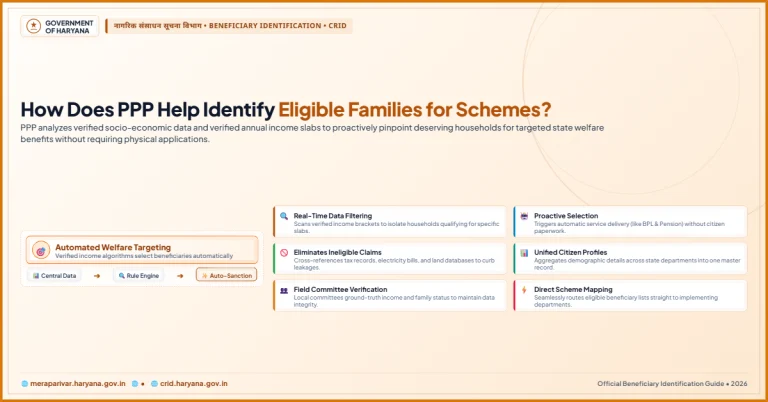
Once verified, the income field in the Family Information Data Repository is marked “Verified” and locked from direct citizen editing. Your Family ID then auto-maps to schemes you qualify for—or removes links you no longer meet.
Single-Member Families Face Stricter Audit
Not all households are treated the same. The government is actively auditing Single-Member Family IDs—individuals registered alone in PPP who may be sliding under the ₹1.80 lakh BPL bracket without a real household to support.
Over 3.54 lakh single-member profiles are under review. Of these, 1.90 lakh declared annual income below ₹1.80 lakh, but only 1.66 lakh had completed BPL verification, leaving roughly 24,000 still outside the verified pool.
If you registered as a single-member family and claimed BPL income, expect closer scrutiny. Delayed verification can pause ration, pension, and health benefits until the record is confirmed.
What the Verified Bracket Means
| Verified Annual Family Income | Status | Practical Impact |
|---|---|---|
| Below ₹1,80,000 | Eligible / BPL | Yellow ration card, health cover, pension, scholarships |
| Above ₹1,80,000 | Standard | BPL benefits removed; standard category applies |
| Asset mismatch or single-member pending | Flagged / Pending | Benefits may pause until revenue order or Gram Sabha confirmation |
Agricultural income up to ₹5 lakh is treated separately. The Chief Minister directed that families should not lose ₹1.80 lakh-linked benefits solely because they also earn up to ₹5 lakh from farming.
How to Check Your Status
Five short steps show whether your income is verified or still pending.
Step 1: Open the Official Portal
Type meraparivar.haryana.gov.in into your browser and load the Mera Parivar site.
Use only this government address—look-alike links can capture your Family ID and OTP.
The portal is the single official entry point for viewing your PPP record.
Step 2: Choose the Family Details Route
On the homepage, locate the Citizen Corner section and select Update Family Details.
This self-service tab is the official entry point for opening your household record.
Do not use agent sites or third-party apps for this check.
Step 3: Enter Your Family ID or Aadhaar
The system asks whether you know your 8-digit Family ID; choose Yes and type the number.
If the ID is not with you, choose No and use the Aadhaar route linked to the Head of Family.
Either path opens the same authenticated record for your household.
Step 4: Complete the OTP Check
A one-time password is sent to the mobile number stored for the Head of Family in PPP.
Enter that OTP in the same session to unlock the record—self-service will not open without it.
Keep the registered handset nearby before you start, or the check will stall.
Step 5: Read the Income Line and Status
Once the record opens, find the income figure listed under the family details.
Check whether it carries a “Verified” mark or still shows as pending/self-declared.
A correct-looking number is not the same as a verified one—status is what schemes read.
Conclusion
PPP income verification in 2026 is local, asset-aware, and stricter on single-member claims. Gram Sabhas now settle rural income figures. Land and vehicle records expose hidden wealth.
Single-member profiles are audited before BPL status is confirmed. Check your Family ID, respond to verification messages, and use the correction or grievance route if the recorded income does not match reality.
Frequently Asked Questions
1. Is Gram Sabha verification now the main physical check for PPP income?
Yes. The Haryana government has directed that income verification be completed through Gram Sabhas on priority, and the Gram Sabha’s decision is treated as final.
2. Does PPP check land and vehicle records during verification?
The system links to land records, tax data, and asset databases. Mismatches are flagged for revenue-level review rather than automatic approval.
3. Why are single-member families audited more closely?
The government is reviewing over 3.54 lakh single-member profiles to confirm that BPL claims reflect real household circumstances, not artificial income splitting.
4. Can I edit my income directly after it is marked “Verified”?
No. Verified fields in FIDR are locked. Changes require a correction or grievance request with supporting documents.
5. What happens if my verified income exceeds ₹1.80 lakh?
Your BPL status updates automatically, and BPL-linked benefits such as yellow ration cards stop.
6. Does agricultural income up to ₹5 lakh affect my ₹1.80 lakh benefits?
The state has directed that families should not lose benefits meant for the ₹1.80 lakh income group solely because they earn up to ₹5 lakh from agriculture—specifically via recorded crop sales on the Meri Fasal Mera Byora portal.